RCD Keeps Tripping? UK Guide to Finding the Faulty Circuit
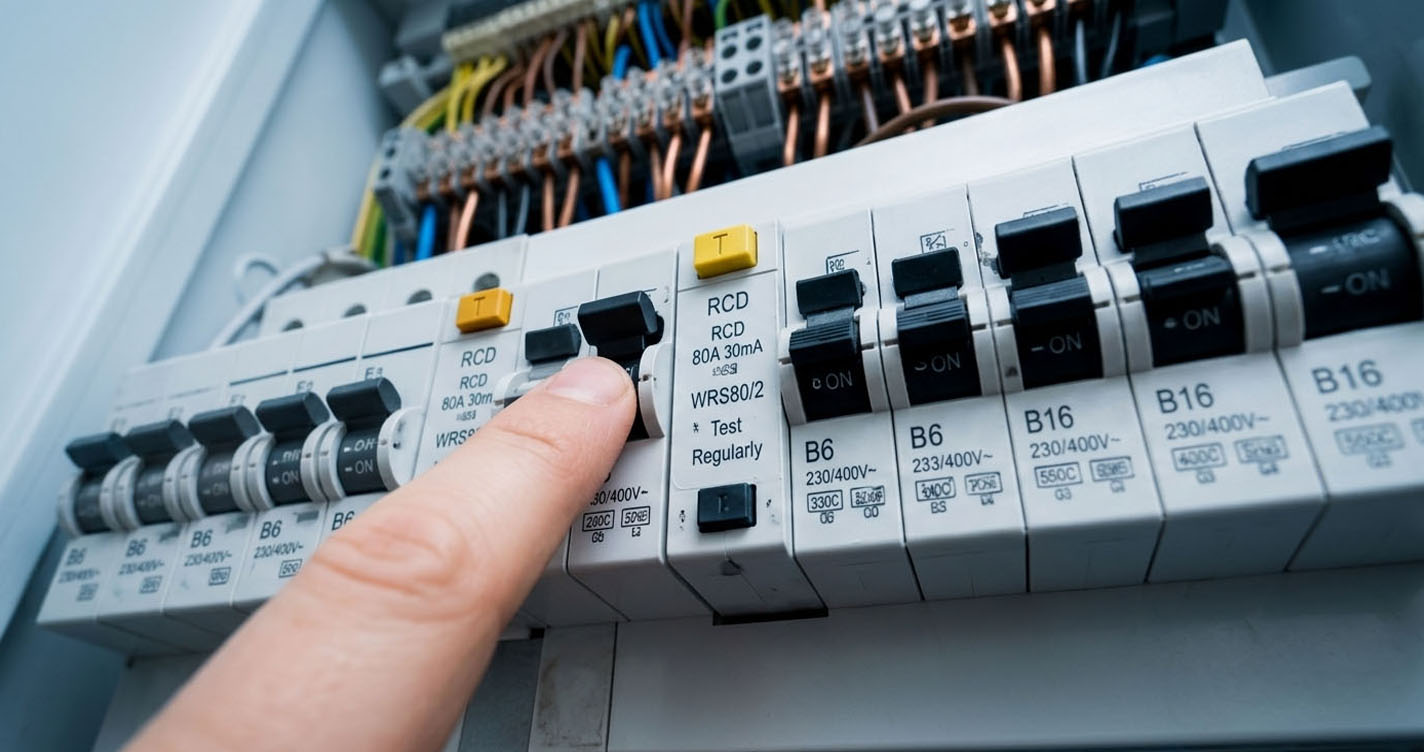
When your RCD keeps tripping, your consumer unit is telling you something on a circuit is leaking current to earth. That is exactly what the RCD is there to catch, and why it exists in every modern UK home: to cut the power in under 40 milliseconds before the leakage becomes a shock risk. The good news is that finding which circuit is faulty is a methodical job most homeowners can do safely in about twenty minutes, using nothing more than the switches on the front of the consumer unit. Actually repairing a wiring fault is not a DIY job, but knowing whether the problem is one bad kettle or something in the fixed wiring puts you in a much stronger position when you ring an electrician.
This guide walks through the safe diagnosis method, the appliance and wiring causes electricians see most often, and the timing clues (overnight trips, rainfall trips, mid-cycle trips) that point straight to the culprit.
The short version
An RCD trips when it detects a small imbalance between live and neutral current, which means electricity is leaking to earth. In UK homes the cause is usually one of three things: a faulty appliance (about 60% of call-outs), damp getting into an outdoor socket or fitting (about 20%), or a fault in the fixed wiring or a hard-wired appliance like an immersion heater or boiler (the remainder). The split-load isolation test in Section 2 finds the faulty circuit in about twenty minutes. If the RCD trips with every MCB off, or trips with nothing plugged in, the problem is in the fixed wiring or the RCD itself and you need a Part P registered electrician.
Quick Symptom Check
Match what your RCD is actually doing to the most likely cause. This is where most of our readers get their answer without reading the whole guide.
| What's happening | Most likely cause | What to do next |
|---|---|---|
| RCD trips only when a specific appliance is running | Failed heating element or motor inside that appliance | Stop using it. Replace or have it repaired by an appliance engineer. |
| RCD trips only after rain or in damp weather | Water in an outdoor socket, garden light, shed feed or bathroom fitting | Isolate the affected MCB and call an electrician to inspect the fitting. |
| RCD trips overnight when nothing is being used | Boiler timer, immersion heater on Economy 7, fridge or freezer defrost cycle, damp finding its way in | Keep a log of exact trip times. Try the split-load test in Section 2 the next morning. |
| RCD trips with nothing plugged in at all | Fault in fixed wiring, or a hard-wired appliance (boiler, immersion, extractor fan, doorbell) | Isolate that circuit at the MCB and call a Part P registered electrician. |
| RCD trips randomly, with no pattern | Cumulative earth leakage from many appliances (nuisance tripping), or an intermittent appliance fault | See Section 5 on nuisance tripping. Consider an all-RCBO consumer unit upgrade. |
| RCD trips instantly, even with every MCB off | Faulty RCD, damaged busbar, or a fault on the incoming meter tails | Do not keep resetting. Call a registered electrician, and in some cases your electricity supplier. |
| RCD trips right after new work: rewire, plumbing, picture hooks | Nail or screw through a cable, disturbed connection, or damp inside the wall | Whoever did the work should return and fix it. It is a common installer error. |
Quick Navigation
- 1. What an RCD Does and Why It Trips
- 2. The Split-Load Isolation Test (Finding the Faulty Circuit)
- 3. Appliance Faults That Trip an RCD
- 4. When Your RCD Trips: Timing Patterns and What They Mean
- 5. Wiring & Fixed-Installation Faults
- 6. Nuisance Tripping & Modern Consumer Units
- 7. When to Call a Registered Electrician (and Costs)
1. What an RCD Does and Why It Trips
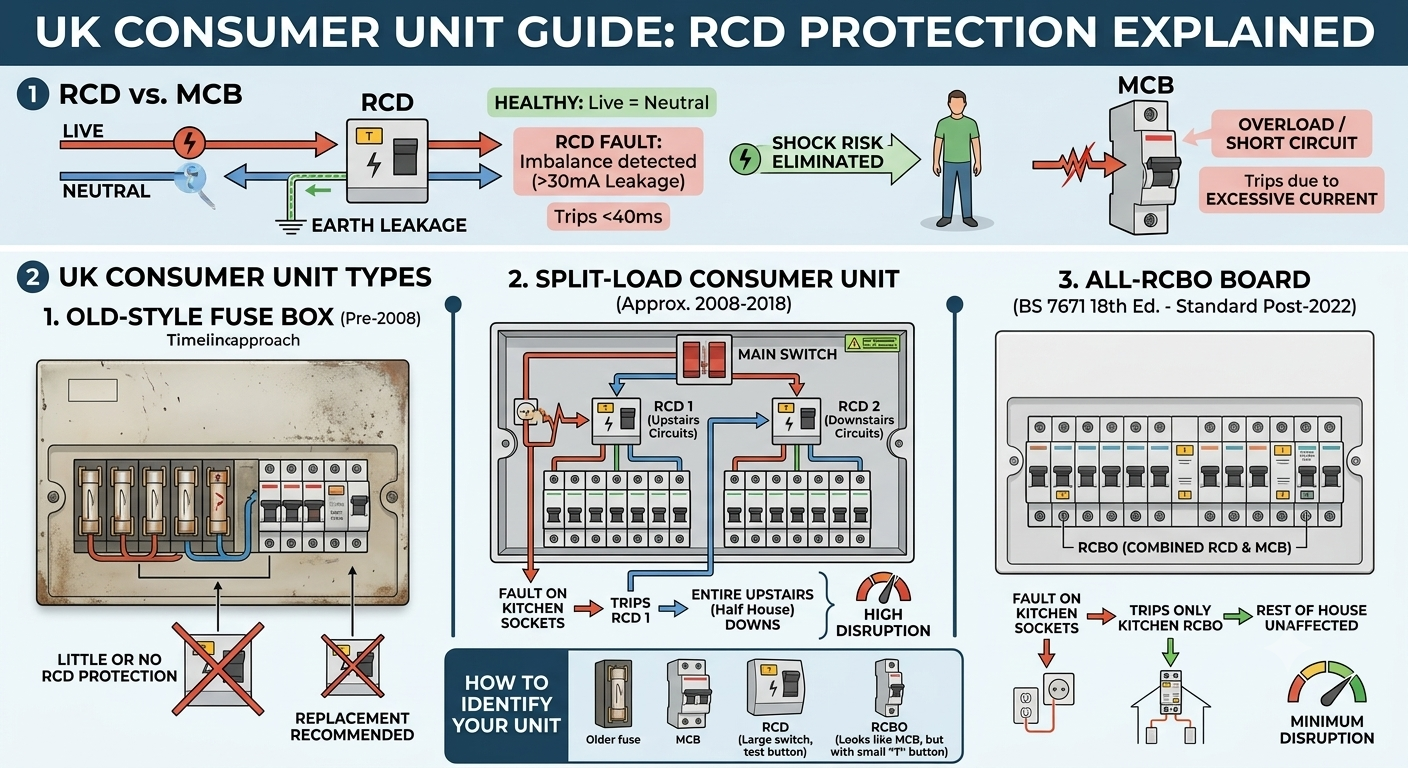
An RCD (Residual Current Device) is the safety switch inside your consumer unit that protects you from electric shock. It constantly compares the current flowing out through the live wire with the current returning through the neutral. On a healthy circuit the two are equal. If even a tiny amount goes missing (typically 30 milliamps) the RCD assumes it is leaking to earth, possibly through a person, and trips within about 40 milliseconds.
This is very different from a fuse or an MCB, which trips because of too much current caused by an overload or short circuit. An RCD trips because of an imbalance, and that imbalance is the signature of an earth fault. For a fuller explanation of how the two protective devices work together, see our guide on why circuit breakers keep tripping in the UK and how it differs from an RCD trip.
Most UK homes fall into one of three consumer unit setups, and which one you have determines how disruptive a fault is:
- Old-style fuse box (pre-2008). Rewireable fuses or older MCBs with no RCD protection at all, or a single RCD covering only certain circuits. If yours looks like this, an upgrade is well overdue. Our guide on why the fuse box keeps tripping in UK homes covers the wider context and what a modern board should look like.
- Split-load consumer unit (roughly 2008 to 2018). Two RCDs, each protecting a bank of MCBs. This is the layout where "the RCD keeps tripping" is most disruptive, because one fault takes out roughly half the house.
- All-RCBO board (BS 7671 18th Edition Amendment 2, standard from 2022 onwards). Every circuit has its own combined RCD and MCB in a single device called an RCBO. A fault only trips its own circuit rather than everything else.
An RCBO is worth understanding because people confuse it with an RCD constantly. It looks like a standard MCB but has a small "T" test button on the front. If your board has these on every circuit, you have the modern layout. If the fault symptoms below look broader than a single circuit (flickering lights across the house, dead sockets, half the house losing power together) see our guide to common electrical faults in UK homes for the wider picture.
2. The Split-Load Isolation Test: Finding the Faulty Circuit
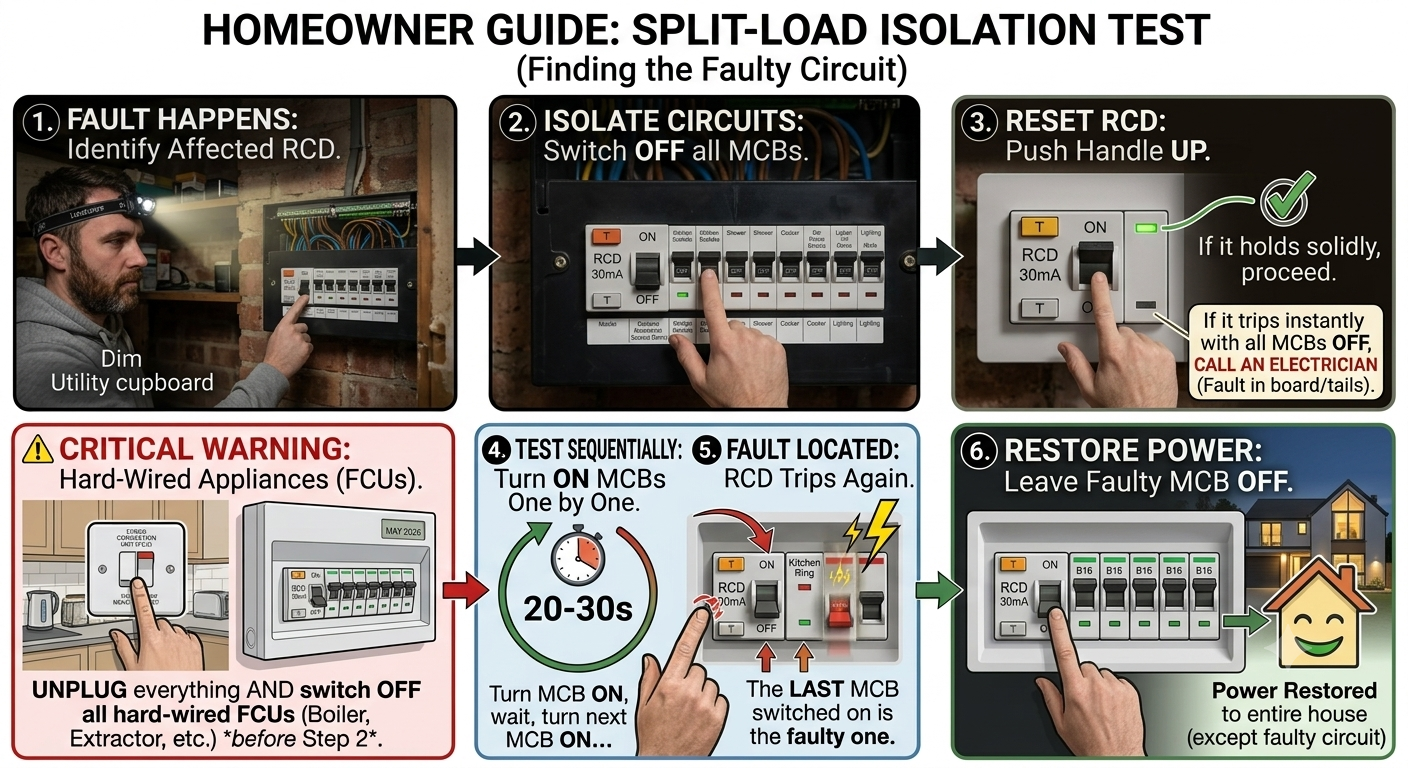
This is the standard method for finding which circuit is causing the RCD to trip. It is safe to do yourself because you are only operating the switches on the front of the consumer unit. You are not opening the board or touching any wiring.
Consumer units are almost always tucked away in a cupboard, hallway, or under the stairs where the light is poor. Working hands-free with an LED head torch makes reading the tiny circuit labels much easier while you flip switches.
- Identify the RCD that keeps tripping. It is the wider switch labelled "RCD" or "30mA" that flips down when the fault occurs. On a split-load board there may be two. Note which one is affected.
- Switch every MCB under that RCD to OFF. The MCBs are the smaller switches next to the RCD. Flip them all down. Leave the RCD itself off.
- Reset the RCD. Push it firmly back up. With all its circuits isolated it should hold solidly. If it drops straight back down with every MCB off, the fault is inside the consumer unit or on the meter tails feeding it. Stop and call an electrician.
- Turn each MCB back on one at a time. Wait 20 to 30 seconds after each. Some faults show up the second the circuit is energised. Others only appear when something on the circuit draws current.
- When the RCD trips, note the circuit. The last MCB you switched on is the faulty one. Common labels: "Upstairs sockets", "Kitchen ring", "Downstairs lights", "Immersion", "Cooker", "Shower".
- Leave that MCB off. Reset the RCD and switch the remaining MCBs back on. Everything else in the house should now be running normally, with just the faulty circuit isolated until you sort the cause.
You now know which part of the house is at fault. The next question is whether it is an appliance plugged into that circuit or something in the fixed wiring. If the trip took out roughly half the house, everything on one side of a split-load board, that is normal for the RCD design and does not mean two faults. See our guide on partial power outage in a UK home for why this happens.
3. Appliance Faults That Trip an RCD
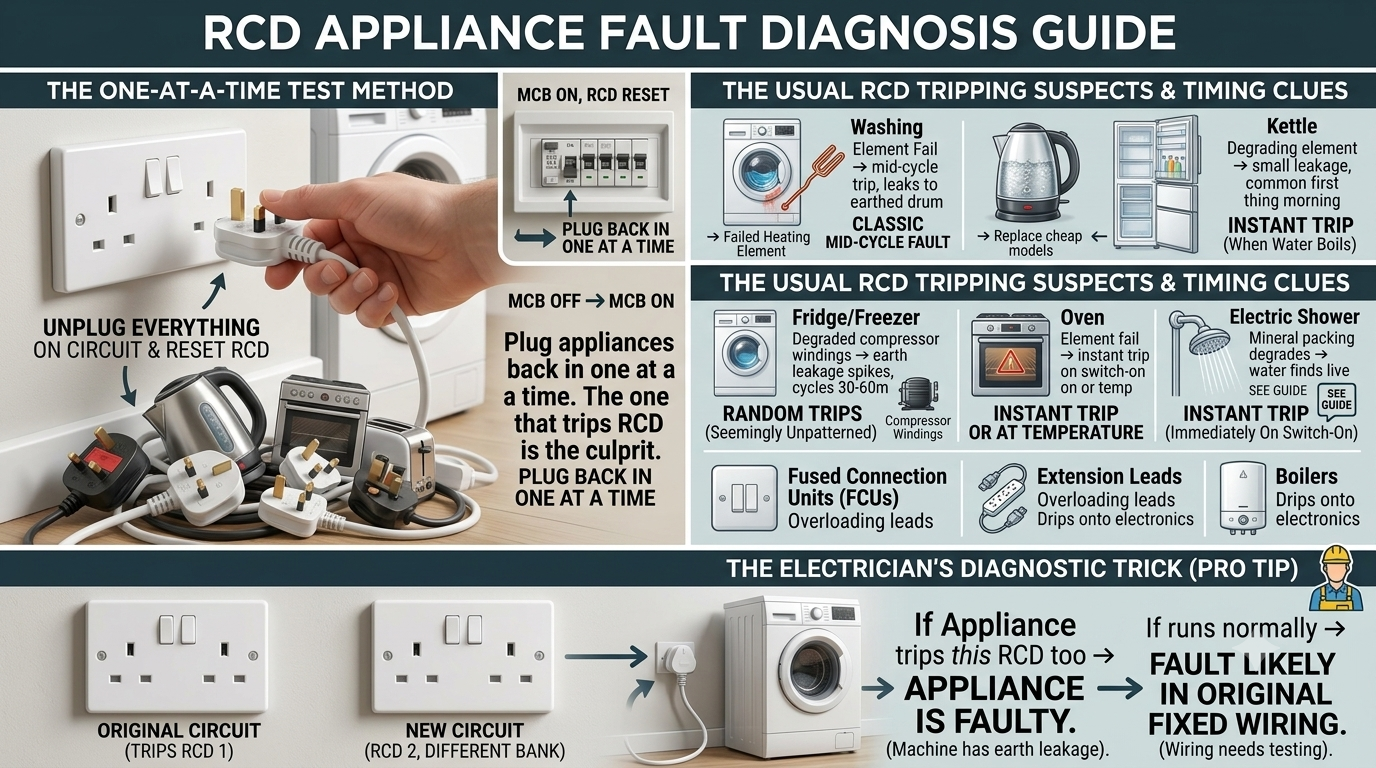
Once you have isolated the faulty circuit, the next test is whether it is an appliance. Unplug everything on that circuit and switch off any FCUs. Reset the RCD, switch the MCB back on. If it now holds, the fault is in one of the things you just disconnected.
Plug appliances back in one at a time, switch each one on and use it briefly. The one that trips the RCD is the culprit. Here are the usual suspects in rough order of frequency, with the specific fault modes to look for.
Washing machines
By far the most-reported appliance in RCD tripping threads. The classic sign is that it trips at the same point in the wash cycle every time, usually when the water starts heating. That points to a failed heating element where the internal insulation has broken down and live current is leaking through the water to the earthed drum. Replacement elements are often under twenty pounds and fittable by an appliance engineer without much drama. Other washing machine causes worth checking: a leaking door seal dripping onto the motor or connections, worn carbon brushes on older machines, and a pressure switch that has become moisture-contaminated.
Ovens and electric hobs
If the RCD trips the instant you switch the oven on, or when it reaches temperature, the oven heating element has failed. Fan-oven elements are the most common. On induction hobs, a cracked ceramic top letting moisture into the coil assembly does the same thing. Stop using it and call an appliance engineer.
Electric showers and immersion heaters
These work hard, and the mineral packing round the heating element degrades over years of heating cycles. Once water finds its way to the live parts of the element, the RCD sees the earth leakage immediately. Tell-tale symptom: the RCD trips the moment the shower is switched on, or when the hot water cylinder fires up in the small hours. If your electric shower is the trigger, our specific guide on the electric shower not working in the UK covers the shower-specific checks.
Kettles and toasters
Older kettles with degraded elements let a small current leak through the water to the earthed casing. Very common first-thing-in-the-morning trigger, when nothing else on the circuit is drawing yet. Kettles under about ten pounds are not worth repairing; replace it.
Fridges, freezers and tumble dryers
Degraded compressor windings on older fridge-freezers cause earth leakage that spikes each time the compressor kicks in. Trips at seemingly random times of day match this pattern, because the compressor cycles roughly every 30 to 60 minutes. Tumble dryers, especially older condenser and vented types, develop the same problem in their heating elements.
Boilers with electronic controls
Modern combi and system boilers have printed circuit boards, pumps, and fan motors that can develop earth leakage over time. If your RCD trips when the boiler fires, isolate the boiler at its FCU and call a Gas Safe registered engineer for the boiler side, and an electrician for the wiring side. A leak inside the boiler that drips onto the electronics is a surprisingly common overnight trip cause.
Extension leads and chargers
Damaged extension leads (cables pinched under furniture, chewed by pets, crushed under a chair leg) will arc to earth. Overloaded leads can also cause trips, and if your leads are hosting a growing pile of appliances, see extension lead overloading in UK homes for the warning signs. Cheap, non-branded phone and laptop chargers with poor EMC filtering also push RCDs over the 30mA threshold when combined with other leakage.
A useful diagnostic trick
Say you think your washing machine is at fault. Unplug it and plug it into a socket on a completely different circuit (a different RCD bank). If the machine now trips that RCD as well, the machine is confirmed faulty. If it runs normally on the other circuit, the fault might actually be in the first circuit's fixed wiring, and the machine was just providing enough load to expose it. This trick, borrowed from working electricians, saves a lot of unnecessary appliance replacement.
4. When Your RCD Trips: Timing Patterns and What They Mean
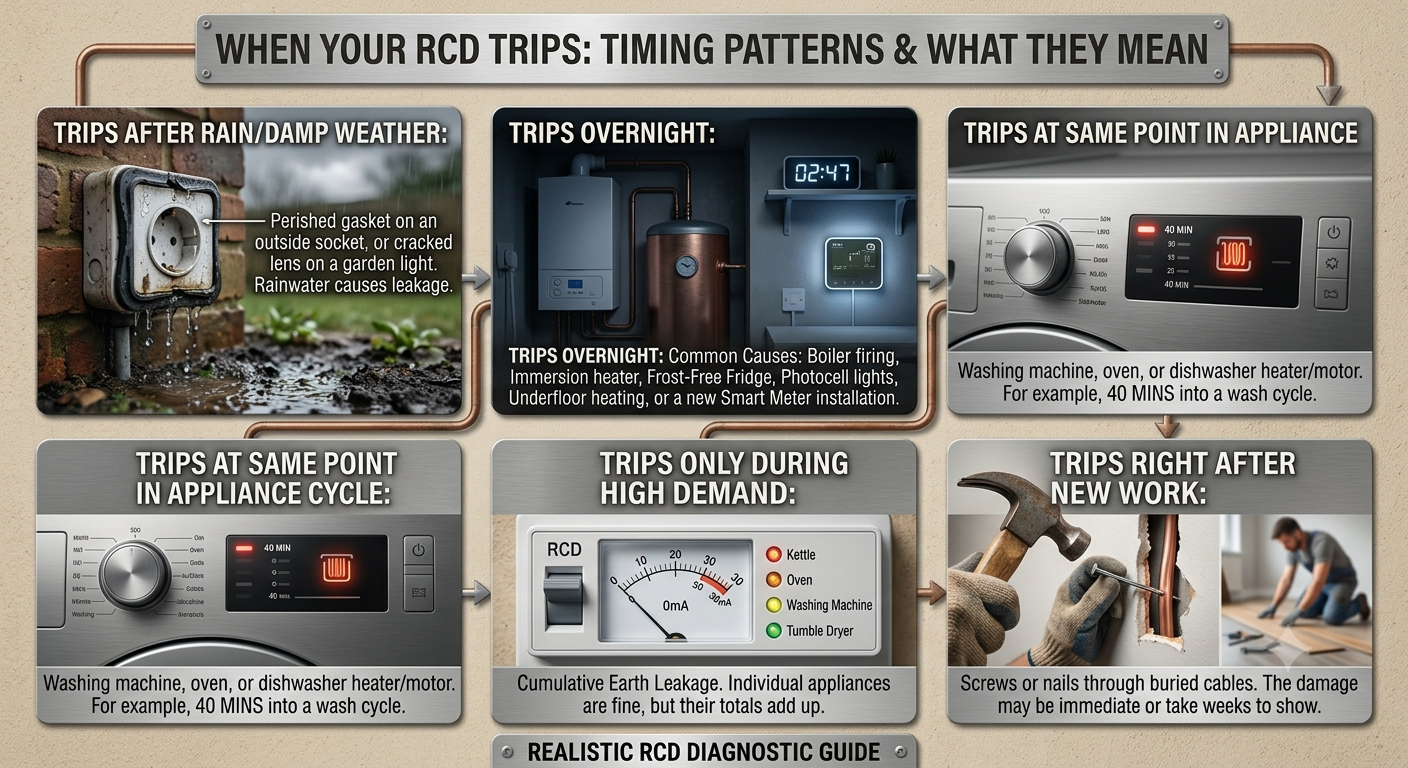
Intermittent RCD trips (the ones without an obvious cause) are the trickiest to diagnose. But when the trip happens often points straight to the fault. Start keeping a note of the exact time, the weather, and what was running.
Trips only after rain or in damp weather
Almost always moisture ingress into an outdoor circuit. Prime suspects: an outside socket with a perished rubber gasket, a garden light with a cracked lens, a shed feed with an over-tightened cable gland, a driveway lamp post, or Christmas lighting left outside all summer. Rainwater tracks across live terminals to earth and the RCD sees the leakage. If the outdoor circuit is on its own MCB, isolate it, unplug all outdoor items and wait for the fittings to dry, then reset. If it holds dry, you have your answer.
Trips overnight when nothing is running
Something is running that you are not thinking about. Common overnight causes include:
- Boiler firing on a heating schedule. A slow leak inside the boiler dripping onto the PCB will only show at certain temperatures.
- Immersion heater on Economy 7. Comes on around 12:30am to 7:30am, exactly when many overnight trips happen.
- Fridge and freezer defrost cycles. Modern frost-free units run a defrost heater every 6 to 12 hours, often overnight.
- Garden and security lighting on a photocell or timer. Comes on at dusk, catches damp on cool evenings.
- Electric underfloor heating on a timer. Older mat-type systems can develop earth leakage.
- Smart meter installations. A common thread on UK forums involves overnight trips starting shortly after a smart meter fit, usually caused by a loose connection at the meter itself. If yours started here, contact the installer.
Trips at the same point in an appliance cycle
Nearly always the appliance's heating element or motor. A washing machine that trips at 40 minutes into every wash is almost certainly the element switching on to heat the water. An oven that trips when it reaches 180°C is the fan-oven element. A dishwasher that trips on the drying cycle is the drying-fan heater.
Trips only during high household demand
Kettle plus oven plus washing machine plus tumble dryer at the same time. This looks like cumulative earth leakage nuisance tripping, covered in Section 6. Individually every appliance is fine, but the totals add up past 30 milliamps and the RCD calls it a fault.
Trips right after new work in the house
New picture hooks, a fitted wardrobe, laminate flooring with gripper strips, a plumber lifting boards, an aerial fitter running cable. Any of these can put a nail or screw through a buried cable. The damage sometimes shows up immediately, sometimes takes weeks as the exposed copper oxidises and starts leaking to earth. If the trips started right after work, that is where to look first.
5. Wiring & Fixed-Installation Faults
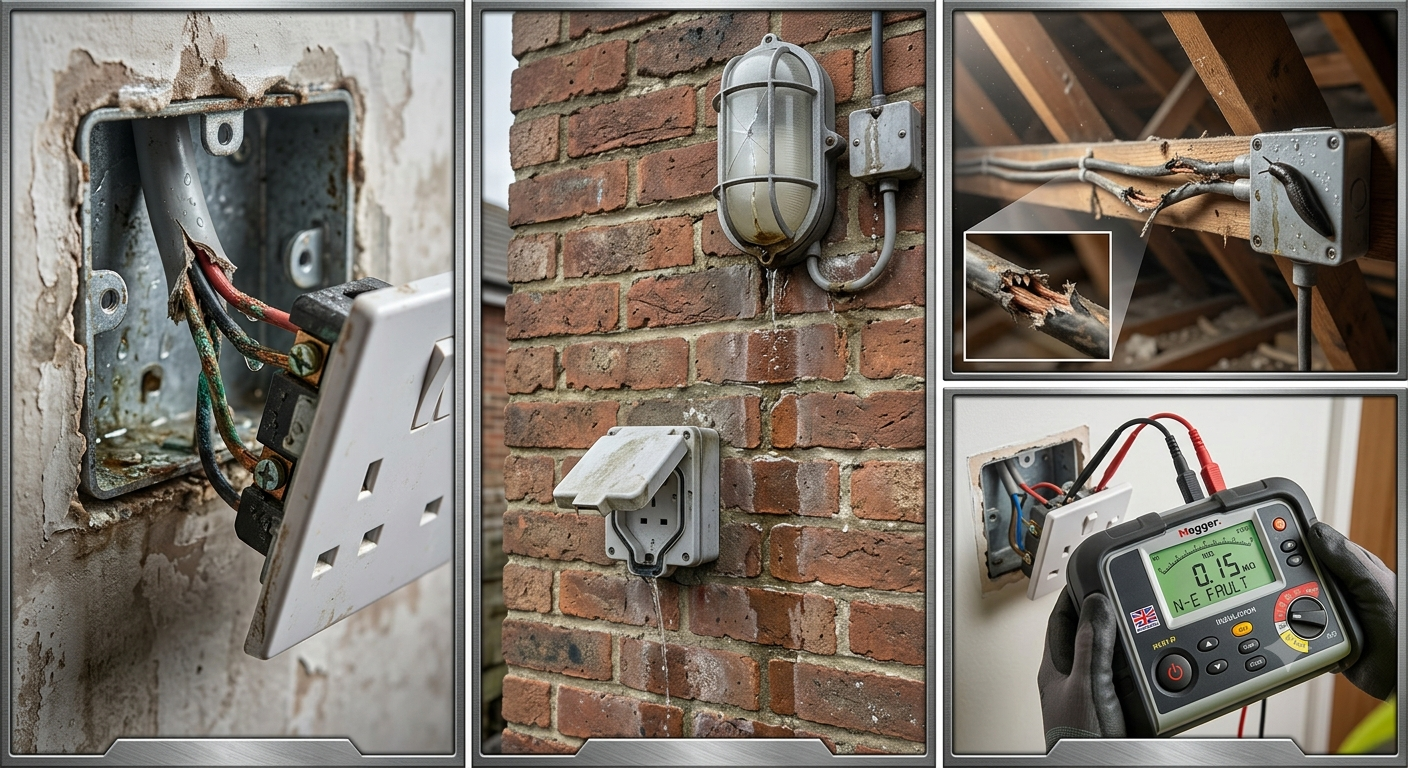
If unplugging every appliance (and switching every FCU off) does not stop the tripping, the fault is in the fixed wiring or a hard-wired accessory. This is not a DIY repair. You need a Part P registered electrician with an insulation resistance tester. Knowing the common causes helps you describe the fault and can save the electrician diagnosis time. Before you call, a plug-in socket tester and a voltage detector pen can help you confirm which sockets on the circuit are actually dead and which are still live, giving the electrician a head start.
Damp cable runs. Water is the single most common cause of wiring-side RCD trips. Rainwater tracks into an outside socket, a shed feed, a bathroom extractor fan, or a light fitting on an external wall. Cables buried in walls that have become damp after a plumbing leak or roof leak cause the same problem indoors. Trips often correlate with rainfall or with the temperature dropping overnight (condensation forming inside back boxes).
Nail or screw through a cable. Cables buried behind plasterboard get nicked when someone hangs a picture, fits a shelf, or lays a carpet gripper. The damage often does not trip anything immediately but starts leaking to earth over the following weeks as the exposed copper oxidises. If your RCD started tripping shortly after DIY or a tradesperson visit, this is the first thing to suspect.
Failed accessory: socket, switch, light fitting or FCU. Loose or corroded connections inside a socket back box, a burnt-out ceiling rose, or a cheap dimmer switch that has broken down internally. Bathroom light fittings and outside lights are the most common failure points. If a specific socket is dead as well as tripping the RCD, our guide on a UK socket not working covers what to check. Flickering lights on the same circuit can point at the same root cause; see lights flickering in a UK home.
Neutral-to-earth fault. A slightly geeky one, but this comes up a lot in real fault-finding. An old socket, junction box, or light fitting has the neutral wire touching earth, often through decades of vibration or a screw that just about grazes both. The circuit works normally most of the time, but the RCD trips as soon as any current flows because the current returning through neutral splits between neutral and earth, and the earth path is what the RCD reads as leakage. Diagnosing this needs proper test gear.
Shared neutrals between circuits. Sometimes found in older UK properties where a rewire was done in stages. Two circuits accidentally share a neutral wire somewhere in the loft, so the balance the RCD is measuring gets confused. Requires a full circuit trace to correct.
Pests, and yes, actual slugs. Real UK electrician forums are full of stories of RCD faults traced to rodents chewing through cable insulation in the loft, slugs finding their way into damp junction boxes, and (memorably) cats spraying into low-level sockets. If you have any of these possibilities in the property, mention it to the electrician. It saves a lot of diagnostic time.
6. Nuisance Tripping & Modern Consumer Units
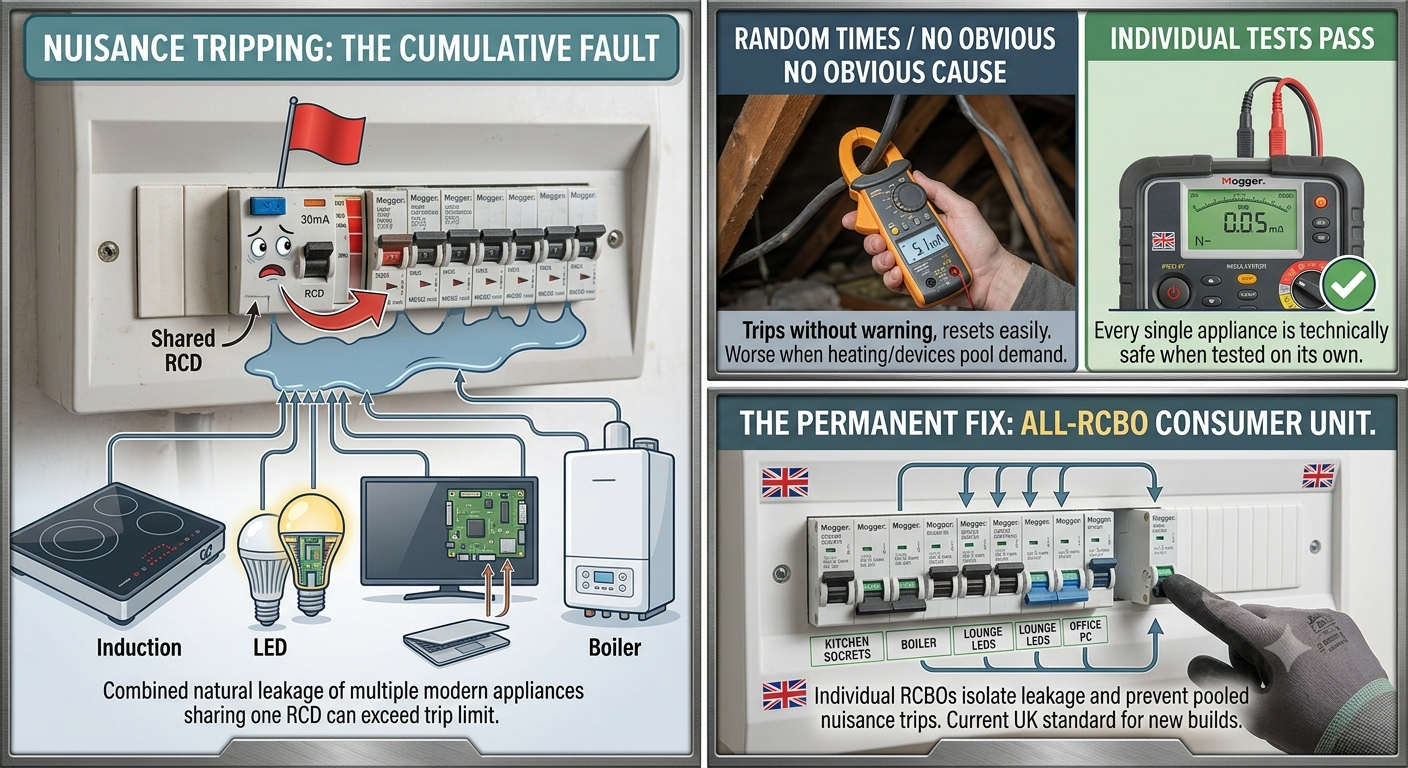
Sometimes an RCD trips even though no single appliance or circuit has an obvious fault. This is called nuisance tripping, and it is a real problem on older split-load consumer units where lots of modern appliances share one RCD.
Every modern appliance (computers, TVs, LED lights, phone chargers, induction hobs, boilers with electronic controls) leaks a tiny amount of current to earth through its internal EMC filter. Each one is well within the safe individual limit. But if you have twenty of them on the same RCD, the combined natural leakage drifts up towards the 30mA trip threshold. A sudden inrush of current, such as a fridge compressor starting or a kettle boiling, pushes it over the edge and the RCD trips even though nothing is actually faulty.
Signs it is nuisance tripping rather than a real fault:
- The trip happens at random times, not tied to any specific appliance.
- Resetting the RCD works fine and it holds for hours or days afterwards.
- Nothing on the circuit was recently added, changed, or damaged.
- It is worse on cold or damp mornings when more heating and appliances are running.
- You never smell anything burnt, and no sockets are discoloured.
The permanent fix is a modern all-RCBO consumer unit. Because each circuit has its own individual RCBO, the natural leakage is not pooled across half the house. Under the current UK wiring regulations (BS 7671 18th Edition, Amendment 2) this is now the standard fit for new installations and re-boards, and it typically costs £600 to £1,200 supplied and fitted by a registered electrician, depending on the number of circuits and the age of the existing wiring.
7. When to Call a Registered Electrician (and What It Costs)
A tripping RCD is one of those faults where the diagnosis is largely DIY-friendly but the actual repair usually is not. Call a Part P registered electrician (NICEIC, NAPIT, or Certsure registered) if any of the following apply:
- The RCD trips even with every MCB off. The fault is inside the consumer unit or the incoming meter tails.
- You have isolated the faulty circuit but no appliance is at fault. The fault is in the fixed wiring and needs insulation resistance testing to locate.
- The RCD trips as soon as it is reset, before you can test anything. A hard fault of this kind usually means a direct short between neutral and earth somewhere on the circuit.
- The trips coincide with rain or damp weather. Water ingress into an outdoor circuit or damp cable needs finding and sealing before the circuit is used again.
- You smell burning, see a discoloured socket, or hear buzzing from the consumer unit. Stop immediately, isolate the affected circuit, and call an electrician the same day.
- You have an old fuse box with no RCD protection at all. A modern consumer unit upgrade is the answer. See our guide on the UK fuse box tripping for what to expect from a re-board.
- You experience persistent nuisance tripping. The fix is an all-RCBO board, not something to attempt yourself.
What it typically costs
Prices vary by region and time of day, but as a rough UK guide for 2026:
- Call-out and diagnosis: £60 to £120 for the first hour. An electrician with proper test gear can usually locate the fault within that time.
- Fault-finding and repair on a single circuit: £150 to £300, depending on how buried the fault is and whether access work is needed.
- Replacement RCD or RCBO in an existing consumer unit: £120 to £250 including the part.
- Full consumer unit upgrade to an all-RCBO board: £600 to £1,200 fitted, sometimes more on older or larger properties.
- Emergency out-of-hours call-out: generally double the daytime rate. Only worth it if the whole house is off and cannot be reset.
Preventing future trips
The single best preventive habit is the quarterly RCD test. Every RCD and RCBO has a small "T" button. Press it once every three months. The device should trip instantly. Reset it and carry on. If it does not trip when tested, it is faulty and needs replacing by an electrician. Beyond that, keep outdoor sockets and lights properly sealed, replace ageing kitchen and bathroom appliances before they fail, and if you are still on an old split-load board and getting nuisance trips, seriously consider the RCBO upgrade.
Questions & Answers
Real questions from homeowners, answered by our team.
Community Questions
RCD Keeps Tripping: FAQs
Why does my RCD keep tripping with nothing plugged in?
If your RCD trips with nothing plugged in, the fault is almost always in the fixed wiring or in a hard-wired appliance rather than something on a plug. Common causes are a damp outdoor socket or light fitting, a nail or screw through a cable behind a wall, a failed extractor fan or boiler, an immersion heater with a broken element, or a neutral-to-earth fault on a socket. Isolate that circuit at the MCB and call a registered electrician to test with an insulation resistance meter.
What is the difference between an RCD, an MCB and an RCBO?
An MCB (miniature circuit breaker) trips on overload or short circuit when too much current flows. An RCD (residual current device) trips on earth leakage when the live and neutral currents do not balance, typically at 30 milliamps. An RCBO combines both jobs in one device, protecting a single circuit against both faults. Modern UK consumer units built under BS 7671 18th Edition Amendment 2 use an RCBO on every circuit rather than a shared RCD.
Is it safe to keep resetting a tripping RCD?
Resetting an RCD once or twice to see if it holds is fine. But if it trips repeatedly, stop pushing it back on. The RCD is doing its job by catching a real earth fault. Forcing it back on masks the problem and wears out the RCD mechanism. Work through the split-load isolation test to find the cause instead, or leave the faulty circuit off and call an electrician.
Why does my RCD only trip when it rains?
Rain-triggered RCD trips are almost always water ingress into an outdoor circuit. The usual culprits are an outside socket with a perished rubber gasket, garden lighting with cracked lenses, a shed feed, or a driveway lamp post. Damp inside a wall after a plumbing or roof leak causes the same symptom in indoor circuits. Isolate the affected circuit at the MCB until an electrician can inspect it and reseal or replace the accessory.
Why does my RCD trip overnight when nothing is running?
Overnight trips usually point to something on a timer or thermostat kicking in when you are not watching. Common causes are a boiler firing on a heating schedule, an immersion heater on Economy 7, a fridge or freezer compressor starting a defrost cycle, or garden lighting on a photocell. Damp finding its way into a socket during cool overnight hours can also do it. Keep a log of the time it trips and what was running to help narrow it down.
Why does my washing machine trip the RCD?
The most common cause is a failing heating element. Water gets past the internal insulation of the element and leaks live current to the earthed drum. You will often notice the trip happens at the same point in the cycle every time, usually when the water reaches heating temperature. Other causes include a leaking door seal dripping onto the motor, worn motor carbon brushes, and pressure switch faults. A replacement element is often under twenty pounds and fittable by an appliance engineer.
Can I replace a faulty RCD myself?
No. Work inside a consumer unit is notifiable under Part P of the UK Building Regulations and must be carried out by a registered electrician. Replacing an RCD needs isolation of the incoming supply and post-installation testing including trip-time and earth loop impedance measurements. Doing it yourself is unsafe, invalidates your home insurance, and will fail the next Electrical Installation Condition Report.
Should my consumer unit have RCBOs instead of RCDs?
For any UK consumer unit installed since Amendment 2 of the 18th Edition wiring regulations, individual RCBOs on each circuit are effectively the standard. An RCBO combines an MCB and an RCD in a single module, so a fault on one circuit only trips that circuit rather than everything sitting under a shared RCD. If you have an older split-load board with two RCDs and are getting nuisance tripping, upgrading to an all-RCBO board is a common improvement.