Fuse Box Keeps Tripping? UK Troubleshooting & Safety Guide
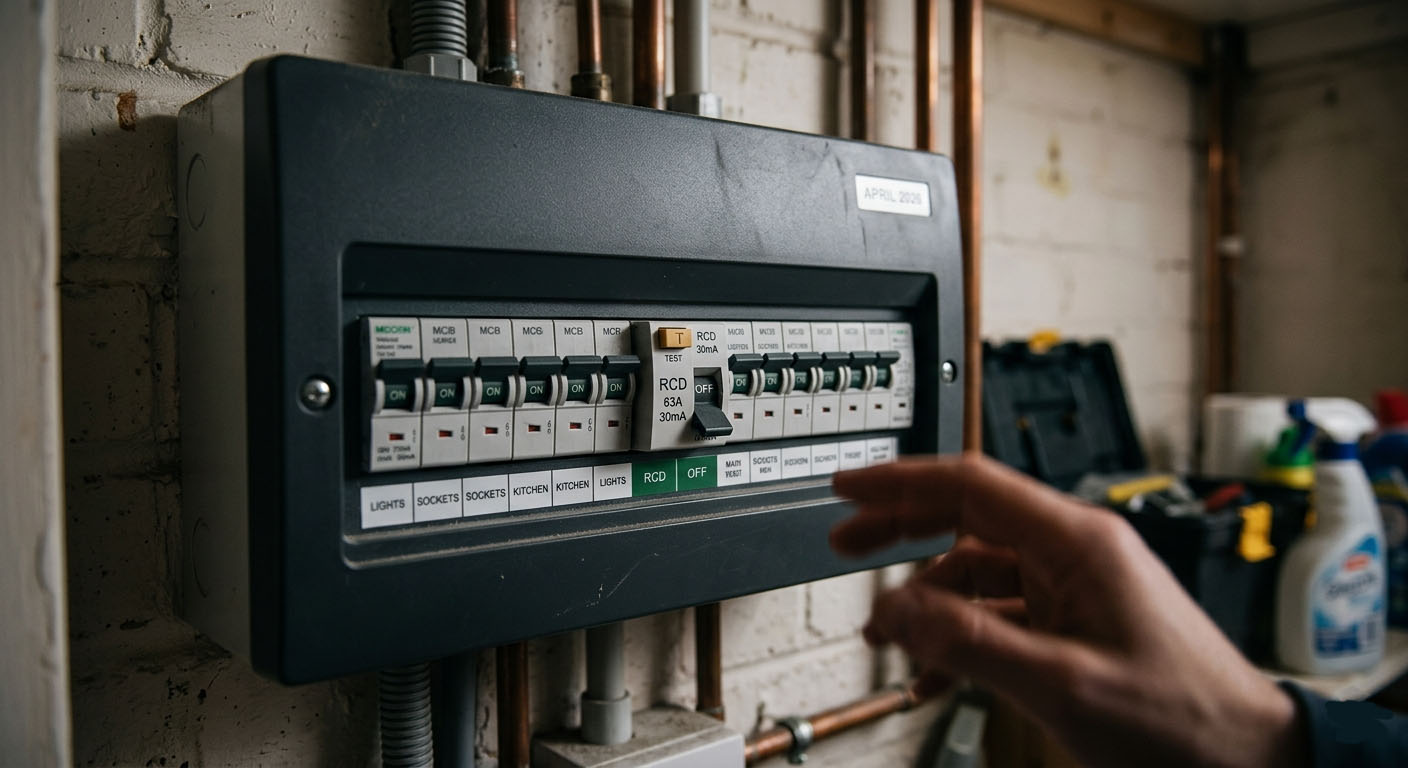
A tripping fuse box — technically a Consumer Unit — is one of the most common electrical problems in UK homes. Every time it trips, it is doing exactly what it was designed to do: cutting power before a fire starts or a person receives a dangerous shock. But when it keeps happening, it means there is an unresolved fault somewhere in your home that needs to be found.
This guide will show you how to tell the difference between an RCD trip and an MCB trip, how to safely identify whether the fault is a specific appliance, a moisture problem, or an overloaded circuit — and critically, when the right answer is to stop troubleshooting and call a professional.
Quick Navigation
1. RCD vs MCB: What Tripped and What Does It Mean?
The first thing to do when your fuse box trips is to look at which switch has gone down. Modern UK consumer units contain two different types of protective device, and the type that tripped tells you a great deal about the cause.
- MCB (Miniature Circuit Breaker) — the small switches: Each MCB protects one specific circuit, such as "Downstairs Sockets," "Upstairs Lights," or "Cooker." If a single MCB has tripped, the problem is almost certainly limited to that circuit — either too many appliances running at once (overload) or a damaged appliance causing a short circuit.
- RCD (Residual Current Device) — the large switch with a "T" or "Test" button: The RCD protects against earth leakage — electricity escaping from a damaged cable or appliance and potentially flowing through a person. When an RCD trips, it often cuts power to half the consumer unit at once. This is almost always caused by a faulty appliance or moisture getting into an electrical fitting.
2. How to Find the Faulty Appliance (Step-by-Step)
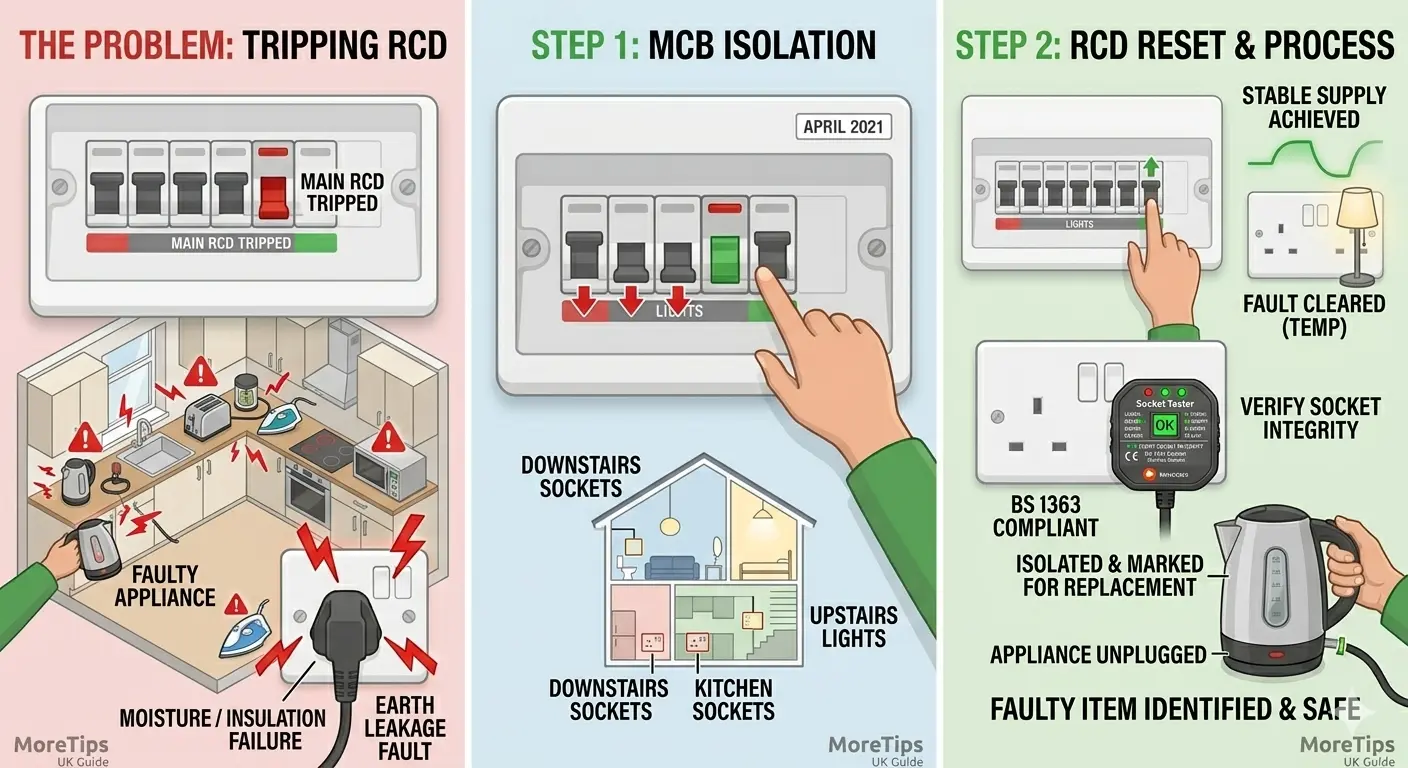
If your RCD has tripped, the fault is almost always a plugged-in appliance. This process takes around 10 minutes and will identify the culprit without needing any tools:
- Turn OFF every individual MCB (the small switches) at the consumer unit. Leave the main RCD alone for now.
- Reset the RCD by flipping the large switch back to ON. With all MCBs off, it should stay up. If it immediately trips again with everything off, the fault is in the fixed wiring — stop here and call an electrician.
- Restore MCBs one by one. Flip each small switch to ON individually. The MCB that causes the RCD to trip again has identified the faulty circuit — for example, "Kitchen Sockets."
- Physically unplug everything on that circuit. Do not rely on wall switches — pull every plug from the wall. Reset the consumer unit again.
- Plug appliances back in one at a time, leaving 30 seconds between each. The appliance that causes the trip when connected is your fault. Remove it from service until it has been PAT tested, professionally repaired, or replaced.
3. Fuse Box Tripping Due to Circuit Overload
If a specific MCB trips when you switch on a high-wattage appliance — a tumble dryer, a fan heater, or a kettle — the most likely cause is a circuit overload rather than a fault. You are simply asking the circuit to deliver more current than it is rated for.
UK ring main circuits are typically protected by a 32-Amp MCB. Running a washing machine (13A), a dishwasher (13A), and a kettle (13A) simultaneously on the same ring main pushes total demand to 39A — well over the limit.
Fixes for circuit overload:
- Stagger the use of high-wattage appliances so they don't run at the same time.
- Move a high-draw appliance to a socket on a different circuit (check your consumer unit labelling to identify which sockets are on separate circuits).
- Ask a Part P electrician to add a dedicated circuit for a consistently overloaded appliance such as a tumble dryer or electric oven.
Do not attempt to solve overloading by replacing the MCB with a higher-rated one. The MCB is sized to match the cable thickness in your walls — upgrading it without upgrading the cables creates a fire risk.
4. Fuse Box Trips When It Rains: Outdoor Sockets and Moisture
If your consumer unit trips specifically during or after heavy rain, or only affects the circuit labelled "Outside," "Garage," or "Garden," the cause is almost certainly moisture ingress into an external electrical fitting.
Over time, the weatherproof seals on IP-rated outdoor socket enclosures, garden lighting fittings, and external PIR sensor housings can crack and perish. Once water finds its way inside, it creates a path to earth that immediately triggers the RCD.
What to do:
- Turn off the affected outdoor circuit at the consumer unit and leave it off.
- Inspect all outdoor sockets, light fittings, and pond pump connections for cracked housings, missing blanking plugs, or perished seals.
- Allow fittings to dry out completely before restoring power — moisture in sealed enclosures can take 24–48 hours to fully evaporate.
- Replace any fitting whose IP rating seal has failed. Outdoor UK sockets should be a minimum of IP44 rated; fittings directly exposed to rain or ground spray should be IP65 or higher.
Fuse Box Tripping: Fault Severity Quick Reference
Use this table to quickly assess the urgency of your situation before taking action.
| Symptom | Most Likely Cause | Urgency | Action |
|---|---|---|---|
| Single MCB trips when appliance is switched on | Faulty appliance or overload | Low | Isolate appliance; redistribute load |
| RCD trips — resets after unplugging one item | Faulty appliance with earth leak | Low | Discard or repair faulty appliance |
| RCD trips only during or after rain | Moisture in outdoor fitting | Medium | Turn off outdoor circuit; inspect and reseal fittings |
| MCB or RCD trips randomly with no appliance cause | Intermittent wiring fault | High | Call a Part P electrician |
| RCD won't reset with everything unplugged | Fault in fixed wiring | High | Call a Part P electrician — do not keep resetting |
| Burning smell or scorch marks near consumer unit | Arcing or loose connections inside board | Critical | Turn off main switch; call electrician immediately |
| Buzzing or crackling from the consumer unit | Loose terminals or arcing inside the board | Critical | Turn off main switch; call electrician immediately |
Safety Tools Every UK Home Should Have Near the Consumer Unit
These two items cost very little and can save you a lot of time — and potentially prevent a fault going undetected.
| Product Image | Essential Tool | UK Standard | Action |
|---|---|---|---|
|
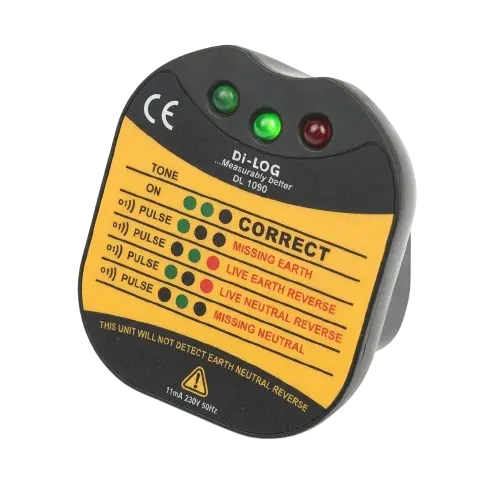
Socket Tester Plug-in, 13A type — checks live, neutral, and earth wiring in seconds without opening the socket |
BS 1363 Compliant | View Info |

|
LED Head Torch Hands-free lighting so you can read switch labels and work safely at the consumer unit when the power is out |
Rechargeable — keep charged | View Info |
When to Stop Resetting and Call a Part P Electrician
DIY appliance isolation is safe and sensible. But there are situations where continuing to troubleshoot yourself is genuinely dangerous. Stop and call a NICEIC or NAPIT registered electrician if any of the following apply:
- The consumer unit won't reset even with every appliance unplugged — the fault is in the fixed wiring, which requires a multifunction tester to locate.
- Tripping is accompanied by a burning smell or scorching near the board — this indicates arcing inside the consumer unit itself, which is a fire emergency.
- You can hear buzzing or crackling from the fuse box — electricity is jumping across a loose connection inside the board.
- The trips happen randomly with no obvious pattern — intermittent wiring faults are the hardest to find and the most dangerous to ignore.
- Your consumer unit is an old rewireable fuse box — wooden-backed boards with ceramic fuse holders and thin rewireable wire offer no RCD protection and should be upgraded.
- The RCD "Test" button does nothing when pressed — your home's earth-leakage protection is not functioning. This is a compliance issue as well as a safety one.
Find a registered electrician via the NICEIC contractor search or the NAPIT member directory. For more context on what an electrician will look for, see our guide on common electrical faults in UK homes.
Summary: How to Deal with a Fuse Box That Keeps Tripping
A tripping consumer unit is your home's safety system working correctly — but the underlying fault still needs to be found and fixed. In most cases, the process of elimination described above will identify a faulty appliance within ten minutes. If the problem persists after all appliances have been unplugged, or if you notice any burning smell, discolouration, or unusual sounds near the consumer unit, treat it as urgent and call a qualified UK electrician rather than continuing to reset the board.
Questions & Answers
Real questions from homeowners — answered by our team.
Community Questions
Fuse Box Tripping: Frequently Asked Questions
Why does my fuse box trip at the same time every day?
Time-specific tripping almost always points to a timed appliance switching on automatically. Immersion heaters, storage heaters, and outdoor security lighting controlled by a timer or smart plug are the most common causes. Check what is scheduled to activate at the exact time the trip occurs and test that device using the isolation process above.
What is a "nuisance trip" on a UK consumer unit?
A nuisance trip occurs when no single appliance is faulty, but the combined small earth-leakage currents from multiple devices — laptop chargers, phone chargers, LED drivers — add up to a level that crosses the RCD's sensitivity threshold. This is more common in homes with a single RCD protecting many circuits. Having an electrician install a split-load consumer unit or an RCBO board (individual RCD protection per circuit) usually resolves it permanently.
Can a light bulb blowing cause the whole house to go off?
Yes, particularly in older UK consumer units without split-load RCD protection. A bulb failing can produce a brief current spike that triggers the main RCD rather than just the individual lighting MCB, plunging the whole board into darkness. Upgrading to a split-load or RCBO-based consumer unit means a single fault on one circuit can no longer affect the rest of the house.
How much does it cost to replace a UK consumer unit in 2026?
A full consumer unit replacement typically costs between £400 and £800 in 2026, depending on the size of the property, the number of circuits, and your location in the UK. The price includes installation, testing, and the legally required Electrical Installation Certificate (EIC). Always obtain at least two quotes and verify the electrician is NICEIC or NAPIT registered before work begins.
Is it safe to keep resetting a tripping fuse box?
No. Resetting a tripping consumer unit without identifying and removing the cause is dangerous. The RCD trips because it has detected something wrong — either an earth leak or an overload. Repeatedly resetting it without fixing the fault means the protection is working, but the underlying hazard remains. If you cannot clear the fault through appliance isolation, leave the affected circuit off and call a registered electrician.