Partial Power Outage in House: Why Half Your UK Home Has No Power & How to Fix It
If half your house has no power, the most likely cause is a tripped RCD or MCB inside your consumer unit (fuse box) — not a problem with the National Grid. Go to your consumer unit, find the switch in the OFF position, unplug all appliances in the affected rooms, and flip it back to ON. Then plug appliances back in one at a time to find the faulty device.
This guide covers every cause of a partial power outage in UK homes in detail — from tripped RCDs and circuit overloads to old rewirable fuse boxes and DNO faults — and tells you exactly when to call 105 or a registered electrician.
Jump to a Section
Quick Fix: Restore Partial Power in 5 Steps
- Locate your consumer unit — under the stairs, hallway cupboard, or garage. Use a torch if needed.
- Find the tripped switch — any MCB or RCD in the OFF (down) position. The label next to it identifies the affected circuit.
- Unplug everything in the rooms without power. Physically remove plugs from sockets — don't just switch them off at the wall.
- Flip the switch back to ON. If it holds, power is restored. Proceed to step 5.
- Plug appliances back in one at a time with a few seconds between each. When the breaker trips again, the last device plugged in is the cause.
If the switch will not hold even with everything unplugged, skip to the electrician section below.
1. Checking Your Consumer Unit (Fuse Box)
In UK homes, your electrical supply is divided into named circuits — for example: Upstairs Lights, Downstairs Ring, Cooker, Shower. Each circuit has its own protective device. When a fault occurs on one circuit, only that circuit loses power; the rest of the house is unaffected. This is by design.
- Where to find it: Consumer units are most commonly located under the stairs, in a hallway cupboard, the kitchen, or a garage. It is typically a grey or white plastic box fixed to the wall.
- What you are looking for: Modern units use MCBs (Miniature Circuit Breakers) — small switches, one per circuit — and one or two wider RCDs (Residual Current Devices) with a TEST button. A tripped device will be in the down or middle position.
- Labels matter: Well-labelled consumer units show which switch controls which area. If yours are unlabelled, it is worth mapping them out when the power is restored — a small torch and a helper makes this quick.
2. Why Did the RCD or MCB Trip?
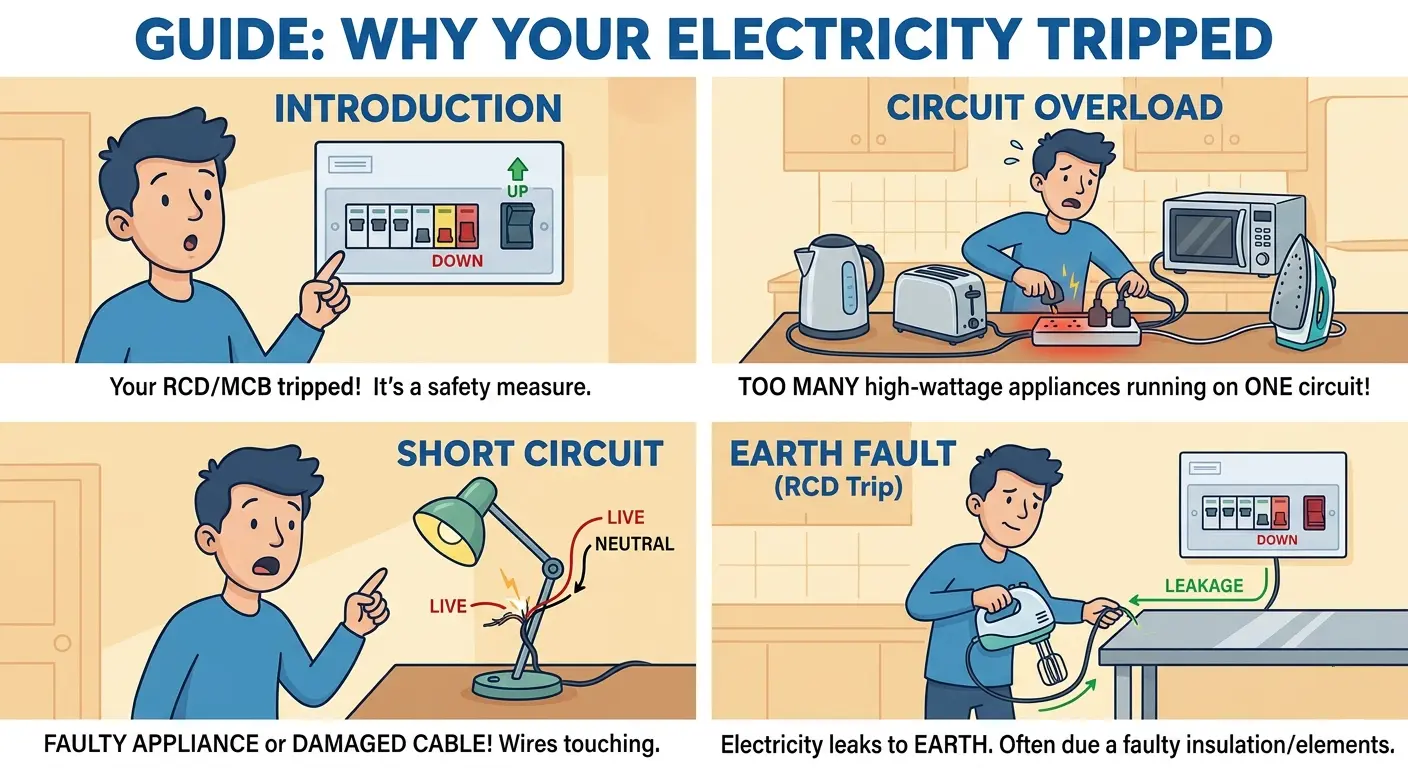
Understanding what caused the trip helps you decide whether this is a straightforward DIY fix or a job for a Part P registered electrician. There are four main causes:
- Circuit Overload: Too many high-wattage appliances running on a single ring main at the same time. Kitchens are the most common location — a kettle (3kW), toaster (1kW), and air fryer (1.5kW) running together can exceed a 32A ring's safe capacity. The MCB trips as a protection mechanism.
- Short Circuit: A live wire touches a neutral wire, creating a sudden massive surge of current. Common causes include a nail driven through a buried cable, a damaged flex on an appliance, or a loose connection inside a plug. The MCB trips almost instantaneously.
- Earth Fault (the main reason an RCD trips): Electricity finds an unintended path to earth — most often through a faulty appliance with a failing heating element (washing machines, dishwashers, tumble dryers) or water ingress in an outdoor socket. The RCD detects the imbalance and cuts power within 30 milliseconds — fast enough to prevent a fatal shock.
- Nuisance Tripping: Modern electronics (computers, phone chargers, LED drivers, smart home devices) each leak a tiny amount of current to earth. If enough of these are on one RCD, their cumulative leakage can exceed the device's 30mA threshold, causing it to trip with no single "fault" to identify. This is increasingly common in homes with a lot of smart devices.
Pro Tip: If your RCD will not stay on even after unplugging everything, the fault is in the fixed wiring, not an appliance. This requires a professional inspection. See our full guide on why circuit breakers keep tripping in the UK.
3. Finding the Faulty Appliance: Process of Elimination
If the breaker trips again the moment you restore power, or trips shortly after, a specific appliance is almost always to blame. Follow this method to identify it without calling an electrician:
- Go to every room without power and physically unplug every appliance — lamps, phone chargers, TVs, washing machines, the lot. Do not just switch the wall socket off; remove the plug entirely, as some devices draw a small current even when "off".
- Return to the consumer unit and flip the tripped MCB or RCD back to ON. If it now holds, you know the fault is in one of those appliances, not the wiring.
- Plug items back in one at a time, waiting 5–10 seconds after each. When the breaker trips again, the appliance you just plugged in is the culprit.
- Set the faulty appliance aside — do not use it until it has been repaired by a qualified appliance engineer or replaced.
Common culprits in UK homes include: washing machines (failing heating elements), dishwashers, electric showers (water ingress), outdoor socket extensions, and old electric blankets or fan heaters with degraded flex.
Recommended Diagnostic Tools
If you cannot identify the fault by the elimination method above, these inexpensive tools can help pinpoint the problem safely.
| Tool | What It Does | Standard | More Info |
|---|---|---|---|
|
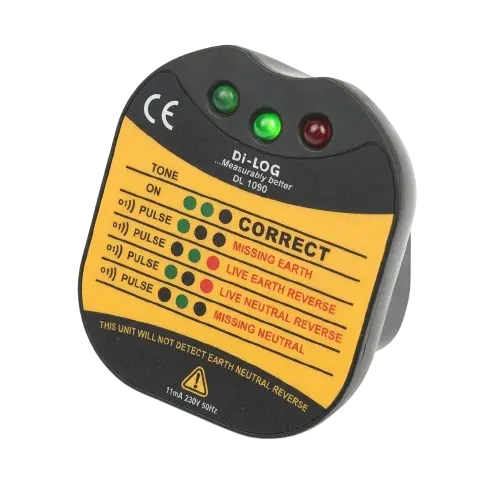
Socket Tester (13A) Plug into any socket to confirm live, neutral, and earth wiring are correct. Instantly identifies wiring faults without tools. |
BS 1363 Compliant | View Info |
|
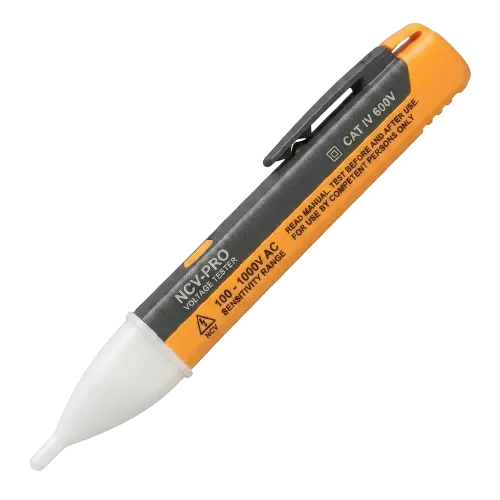
Non-Contact Voltage Detector Pen Detects live voltage without touching wires. Useful for confirming whether a socket or cable is live before touching it. |
CAT II / CAT III Rated | View Info |

|
LED Head Torch (Rechargeable) Essential for working hands-free in a dark hallway cupboard or under-stairs consumer unit. |
Rechargeable, 200+ lumens | View Info |
4. Older Homes: Rewirable Fuse Boxes (Wylex / MEM)
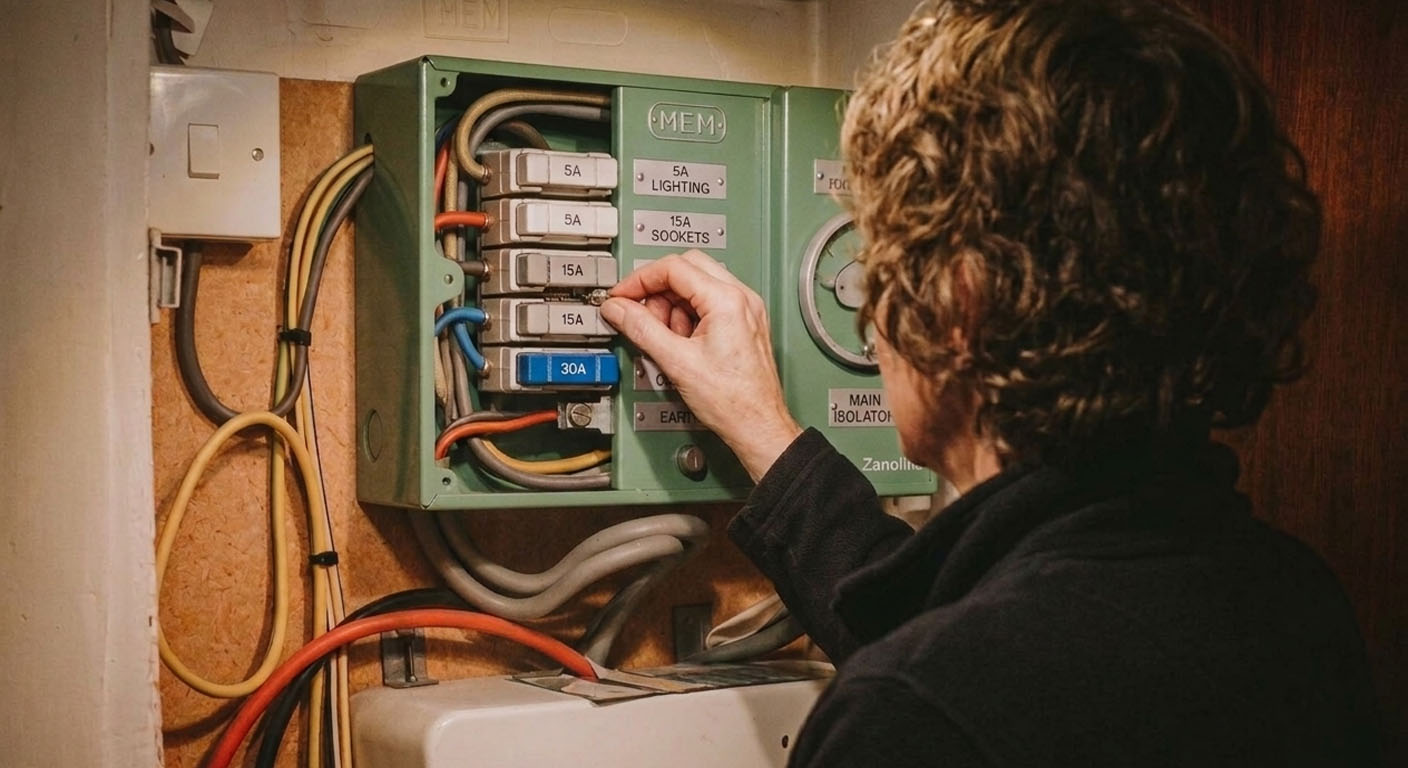
If your home was built before the 1980s and has not been rewired, it may still have an older rewirable (porcelain carrier) fuse box from brands like Wylex or MEM. Instead of switches, these use replaceable fuse wire. A partial outage means a fuse wire has melted.
Always turn off the Main Switch before handling any fuse carrier. Pull out the carriers one at a time to find the one with a broken or blackened wire. Replace it with fuse wire of the correct current rating:
- 5 Amp (white) — lighting circuits
- 15 or 20 Amp (blue/yellow) — immersion heaters, storage heaters
- 30 Amp (red) — ring main / socket circuits
- 45 Amp (green) — cooker or electric shower
If the replacement fuse wire blows instantly, do not keep replacing it — this indicates an ongoing fault on the circuit. At this point, call a registered electrician. It is also worth noting that rewirable fuse boxes without RCD protection do not meet current UK wiring regulations (BS 7671) and a full consumer unit upgrade is advisable for both safety and insurance purposes.
When to Call 105 or a Registered Electrician
Call 105 (free, 24/7) if:
- Your neighbours on the same street are also experiencing power loss — this suggests a DNO (District Network Operator) fault, not an internal one.
- You can see damage to the overhead service cable coming into your property, or sparks from the street-side equipment.
- Your consumer unit switches are all ON but you still have no power — this may indicate a dropped phase or loose neutral on the supply side, which is the DNO's responsibility to fix at no charge to you.
Call a NICEIC, NAPIT, or STROMA registered electrician if:
- Your RCD or MCB will not hold even with all appliances unplugged — this indicates a hard fault in the fixed wiring, such as a nail through a buried cable or rodent damage.
- You smell burning plastic or see scorch marks on switches, sockets, or inside the consumer unit.
- You have an old rewirable fuse box without RCD protection and fuses keep blowing.
- Power is lost only during high winds or bad weather — suggesting a fault in the overhead service cable between the street and your meter tails.
Find a registered electrician via the NICEIC contractor search or the NAPIT member finder.
Summary
A partial power outage in a UK home is almost always caused by a tripped MCB or RCD in your consumer unit, triggered by a faulty appliance, a short circuit, or an earth fault. In the vast majority of cases, unplugging appliances and resetting the breaker restores power in under 10 minutes. If the breaker will not hold, or if you notice burning, buzzing, or scorching, stop immediately and call a NICEIC or NAPIT registered electrician. For street-level faults, call 105 — it is free and available around the clock.
Questions & Answers
Real questions from homeowners — answered by our team.
Community Questions
Frequently Asked Questions
Why is only the upstairs power out?
UK homes are typically wired with separate ring mains for upstairs and downstairs. A fault in an upstairs appliance — or moisture affecting a bathroom light fitting or loft tank — will trip the upstairs circuit only, leaving the ground floor unaffected.
What is the difference between an MCB and an RCD?
An MCB (Miniature Circuit Breaker) is the individual switch protecting a single circuit against overloads and short circuits. An RCD (Residual Current Device) is the wider switch with a TEST button that protects against electric shock by detecting any leak of current to earth. A tripped RCD typically cuts power to multiple circuits at once, while a tripped MCB affects only one.
Why won't my RCD switch stay in the ON position?
If the RCD snaps back down immediately, there is a permanent fault on the circuit — either a faulty appliance still plugged in, or damaged fixed wiring. Unplug every single appliance on that circuit, then try resetting again. If it still will not hold, the fault is in the wiring and you need a registered electrician.
Can outdoor sockets or lights cause a partial power outage indoors?
Yes — very commonly. In many UK homes, outdoor sockets and lights share the same ring main as indoor sockets. If water gets into an outdoor socket, a garden light fitting, or an exterior junction box, it will trip the shared RCD, cutting power to all indoor sockets connected to it. This is one of the most common causes of partial power loss after heavy rain.
Could the partial outage be caused by my smart meter?
This is very unlikely. Smart meter faults almost always result in a total loss of supply, not a partial one. If only one area of your home has lost power, the cause is almost certainly a tripped circuit inside your consumer unit rather than the meter itself.
How much does it cost to fix a partial power outage in the UK?
If a tripped breaker and a faulty appliance are the cause, the fix costs nothing (beyond potentially replacing the appliance). If a qualified electrician is required for a wiring fault, expect a call-out fee of £50–£90 plus an hourly rate of £40–£70. Emergency out-of-hours call-outs typically run £100–£150 or more. DNO faults (call 105) are always free to resolve.