What Not to Plug Into an Extension Lead: The Complete UK Safety Guide
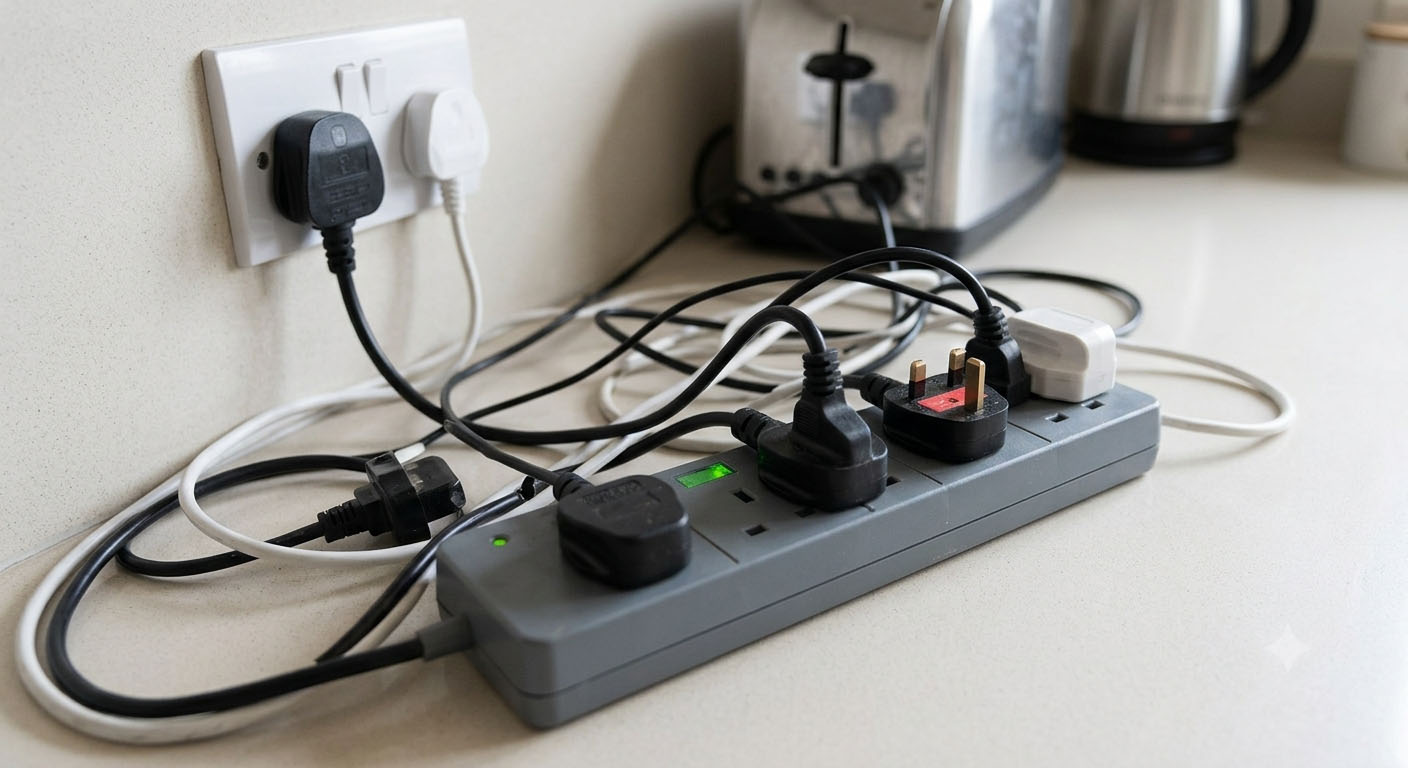
It is an incredibly common sight in modern UK homes: a single wall socket turned into a four-way or six-way hub to power a mess of entertainment systems, kitchen appliances, or home office configurations. While extension leads are handy, they have a strict physical limit that many homeowners unknowingly breach.
Overloaded sockets and faulty electrical appliances are estimated to cause around 7,000 house fires across the UK every year. Knowing the difference between low-current accessories and high-drain appliances can save your home from a devastating electrical fire.
Quick Answer: What Not to Plug Into an Extension Lead
Never plug heat-generating or high-draw appliances into a standard UK extension lead. This includes:
- Kettles & coffee makers (2,200W–3,000W)
- Electric & fan heaters (2,000W–3,000W)
- Fridges & freezers – always use a dedicated wall socket
- Washing machines, tumble dryers & dishwashers (2,000W–2,500W)
- Microwaves & air fryers (1,500W–2,400W)
These devices can push a lead past its 13-amp (roughly 3,000W) rating on their own, or carry risks beyond wattage alone. Full breakdown below, plus a load calculator.
Quick Navigation
1. The 13-Amp Rule: How to Calculate Your Load
In the United Kingdom, standard domestic wall sockets operate on a 230V ring main circuit. Almost every modern trailing extension lead you buy is rated for a maximum load of 13 Amps, which equates to roughly 3,000 Watts (3kW) of total power.
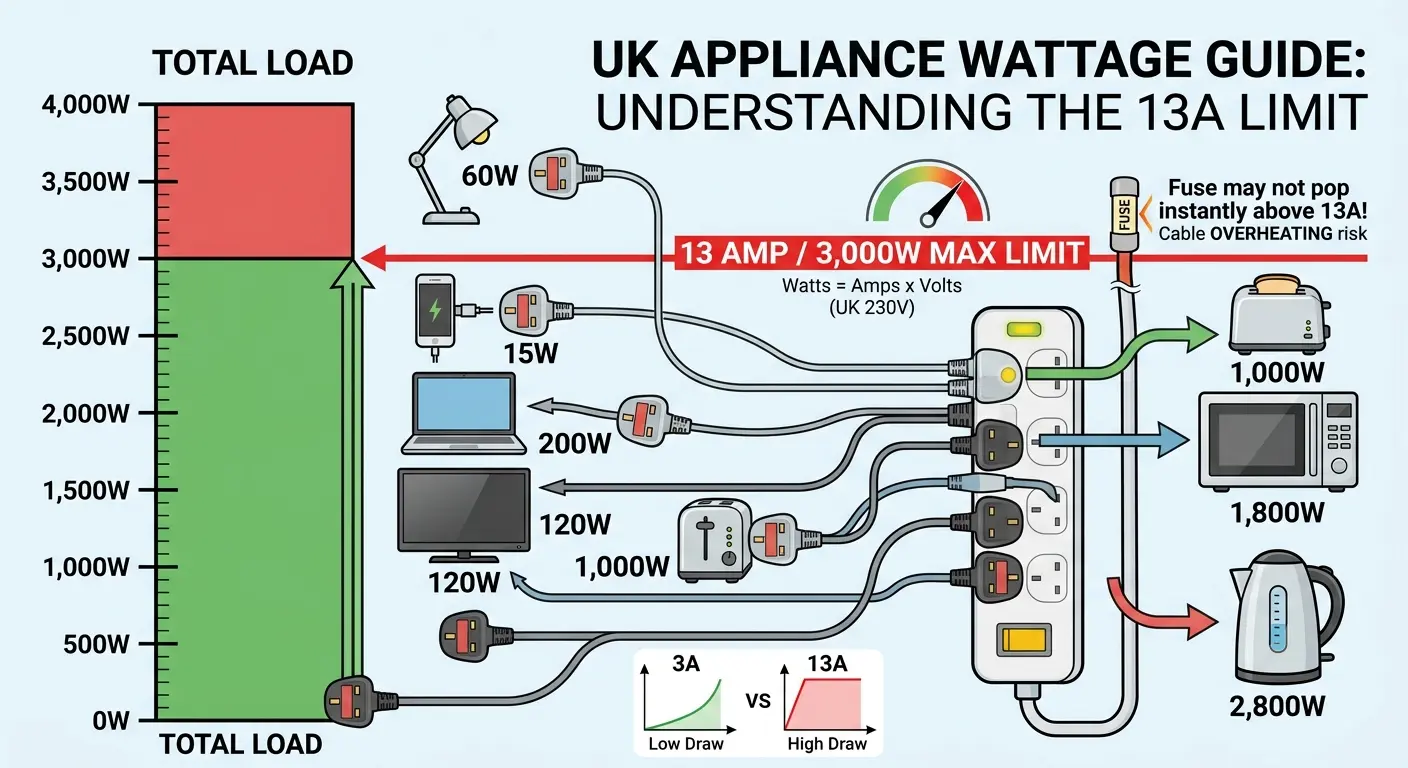
- Amps vs. Watts: To find out how much load you are placing on an extension lead, you simply need to look at the ratings label on your appliances and add their wattages together. The basic formula is: Watts = Amps × Volts. Because UK voltage is 230V, any setup exceeding roughly 3,000W total will overload a standard 13A fuse.
- The Danger of Hidden High-Draw Units: A typical phone charger draws less than 15W, and a desktop television draws around 100W. You could plug dozens of these into a strip safely if you had the slots. However, a single domestic kettle or tumble dryer draws up to 3,000W all by itself.
- Why the Fuse Doesn't Always Save You: Many homeowners assume that if they overload an extension lead, the fuse inside the 13A plug will instantly pop. In reality, a standard BS 1362 fuse can sometimes tolerate a minor overload (such as 14 or 15 Amps) for several minutes or even hours before blowing. During this window, the copper cable can overheat dramatically, melting the plastic insulation and creating a fire risk.
Fuse Rating Chart: What Goes on a 3A vs. a 13A Fuse
UK plugs are fitted with either a 3A or 13A fuse depending on the appliance. Use this as a quick reference when working out what's safe to group together:
| Fuse Rating | Typical Appliances |
|---|---|
| 3A | Table lamps, standard lamps, televisions, DVD players, computers, mixers, most blenders, fridges and freezers |
| 13A | Washing machines, dishwashers, microwaves, kettles, toasters, irons |
Calculate Your Extension Lead Load
Tick the items you're planning to run from one extension lead. The running total updates automatically against the standard 13A (3,000W) limit.
Extension Lead Load Calculator
Illustrative wattages only – always check the rating label on your actual appliances. This tool is for guidance and does not replace checking your extension lead's printed rating.
2. The Red List: What Not to Plug Into an Extension Lead
As a golden rule of household electrical maintenance, any appliance that generates heat, has a powerful motor, or runs continuously should be plugged directly into a fixed wall socket rather than a trailing multi-way extension block.
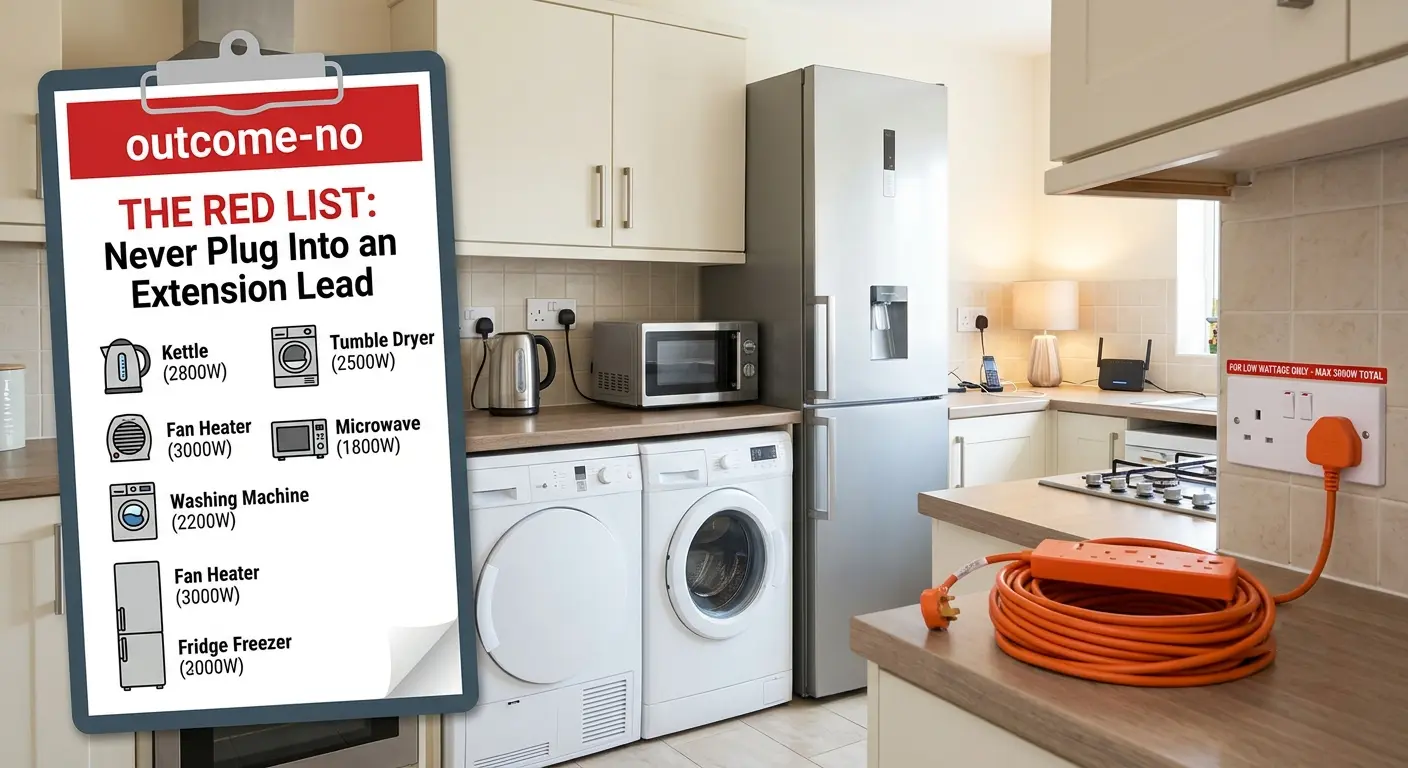
High-Risk Appliance Diagnostic
Below is a diagnostic guide regarding common appliances homeowners incorrectly attach to multi-way blocks.
Safe for Quality Extensions
Low-Wattage electronics: These draw minimal steady-state currents and do not strain cables.
- Laptops & Desktop PCs (~60W - 500W)
- Televisions & Soundbars (~80W - 150W)
- LED Table Lamps & Routers (~10W - 30W)
- Phone & Tablet Chargers (~15W)
Never Plug Into an Extension
High-wattage, motor-driven, or continuously running appliances: these will rapidly exhaust your 13A threshold on their own, or carry risks beyond wattage alone.
- Electric Heaters / Fan Heaters (2,000W - 3,000W)
- Kettles & Coffee Makers (2,200W - 3,000W)
- Fridges & Freezers – always need a dedicated socket, regardless of wattage
- Washing Machines, Dishwashers & Tumble Dryers (2,000W - 2,500W)
- Microwaves & Air Fryers (1,500W - 2,400W)
Why Fridges and Freezers Are a Special Case
Fridges and freezers don't just draw more current on startup than their running wattage suggests – they also cycle on and off automatically, and a voltage drop from a shared extension lead can affect their cooling performance and put food safety at risk. These appliances should always be plugged directly into their own dedicated wall socket, never a shared extension block, regardless of what else is on the lead.
The same logic applies to other fixed high-draw appliances around the home. An electric shower, for example, should run from its own dedicated circuit with a 45A pull-cord isolator switch – never an extension lead. If yours has stopped working altogether, that's a wiring fault rather than an overload issue; see our guide on an electric shower not working for troubleshooting steps.
Pro Tip: If you absolutely must use an extension block temporarily in an emergency for a medium-draw appliance, make sure it is the only thing plugged into that block, and check the rating tag on the cord to confirm it uses thick 1.25mm² or 1.5mm² core cable.
3. The Danger of Daisy-Chaining Blocks
"Daisy-chaining" is the practice of plugging one extension lead directly into another to extend your reach across a room or add more sockets. This is highly dangerous and explicitly warned against by UK fire safety bodies – only ever use one extension lead per wall socket.
Why Daisy-Chaining Increases Fire Risks:
- Increased Resistance: Every mechanical connection plug point introduces minor electrical resistance. When you string multiple blocks together, the cumulative electrical resistance increases. This resistance creates localized heat buildup at the socket interfaces.
- Sustained Earth Fault Loop Impedance: Stringing blocks creates an excessively long path for electricity to clear faults. This can increase your home's earth fault loop impedance to a point where your consumer unit's RCD or circuit breaker might fail to trip quickly during a short circuit, allowing cables to glow red hot.
- Coiled Cable Induction: If you use a drum or reel extension lead, you must fully uncoil it when using high loads. Keeping a trailing cable tightly wound creates an electromagnetic inductor effect, trapping heat in the core of the drum and melting the wire rapidly.
- The First Fuse Can't Protect the Second Lead: The 13A fuse in the first plug is only rated to protect that first lead. It cannot detect an overload building up further down the chain, leaving the rest of the setup effectively unprotected.
4. My Extension Lead Keeps Tripping – What Does It Mean?
A lead that repeatedly trips your circuit breaker or RCD is doing its job – but it's telling you something is wrong. Work through these causes in order:
- 1. Overloaded circuit Unplug everything from the lead, then reconnect items one at a time. If it trips again once a specific appliance is added, that device is likely drawing more than the lead or circuit can handle. For a broader look at why breakers trip, see our guide on circuit breakers that keep tripping.
- 2. A faulty appliance, not the lead Plug the suspect appliance directly into a wall socket. If it still trips the circuit, the fault is with the appliance itself, not the extension lead – our roundup of common electrical faults in UK homes covers what to check next.
- 3. A faulty or damaged lead Try a different, known-good extension lead with the same appliances. A digital multimeter can confirm continuity if you want to test it properly. If the tripping stops, the original lead has an internal fault and should be replaced – never repaired with electrical tape.
- 4. Nuisance tripping from surge-protected leads Some surge-protected leads use components that degrade over time and can cause intermittent RCD trips even without an obvious overload. If a surge-protected lead is several years old and trips unpredictably, replacing it often resolves the issue.
- 5. A wiring or consumer unit fault If the circuit trips even with nothing plugged into any socket on it, the problem is upstream in your home's wiring or consumer unit – especially if you're also losing power to sockets in just one part of the house. See our guide on a partial power outage for what that can mean. This needs a registered electrician, not a new extension lead.
5. Visual Safety Checklist & Warning Signs
Perform a quick physical sweep of your extension blocks every few months to identify potential thermal hazards before they evolve into an electrical fire.
- The Smell Check: Fishy or pungent chemical smells coming from your sockets are a classic symptom of urea-formaldehyde plastic arcing and overheating.
- The Touch Test: Run your hand down the length of your extension lead cord while it is operating. It should feel completely cool. Warmth indicates undersized wiring or overloading.
- Visual Discoloration: Inspect the structural plastic face around the 3-pin entries. Any yellowing, browning, or warping means the internal metal pins are losing tension and creating high-resistance micro-arcs.
- The Buzz Test: A faint buzzing sound from the strip means loose internal contacts are micro-arcing. Replace the lead immediately.
For extra reassurance before you inspect anything by hand, a voltage detector pen lets you confirm a socket or plug is safe to touch first. And if you're also noticing flickering lights elsewhere in the property, that's often connected to the same underlying issue – see our guide on lights flickering in a UK home.
6. Extension Leads in Rented Homes: Who's Responsible?
Many tenants end up relying heavily on extension leads simply because a rented property doesn't have enough wall sockets, or the existing wiring is outdated. Overloading a lead yourself isn't a criminal offence, but your landlord does have legal duties to keep the property's electrical installation safe.
If a lack of sockets or a suspected wiring fault is forcing you into unsafe extension lead use, raise it with your landlord in writing first – and if a specific outlet has stopped working altogether, our socket not working guide can help you describe the fault accurately. If the issue isn't resolved, you can contact your local council's Building Control or Environmental Health team, or Citizens Advice, for guidance on your rights as a tenant. Ask whether the property has a current Electrical Installation Condition Report (EICR) – landlords are expected to have the electrical installation inspected and issued with a satisfactory report.
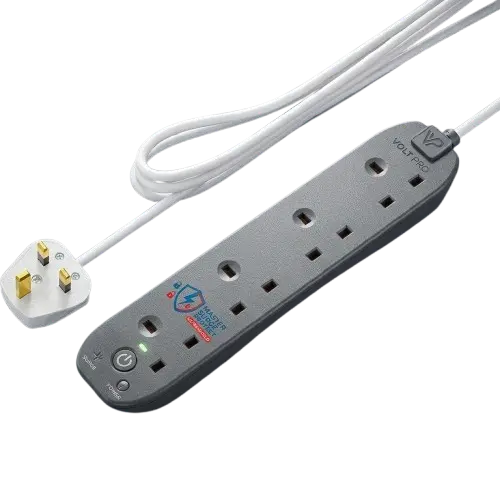
Essential Safe Extension Gear
| Product Image | Essential Safety Tool | Why You Need It | Action |
|---|---|---|---|
|
Surge Protected Extension | Safeguards sensitive computing gear while providing certified physical overload protection. | Check Price |
|
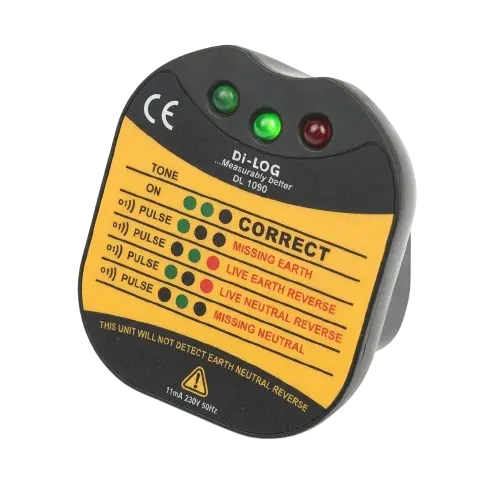
13A Plug Socket Tester | Verifies that your underlying wall socket is correctly earthed and wired before adding extensions. | View Guide |
Questions & Answers
Real questions from homeowners — answered by our team.
Community Questions
Extension Lead FAQ
Can I plug a kettle into an extension lead?
It's not recommended. A kettle can draw close to 3,000W on its own, which uses almost the entire capacity of a standard 13-amp extension lead. Plug kettles and other heat-generating appliances directly into a wall socket instead.
Can you plug a fridge or freezer into an extension lead?
No. Fridges and freezers should always be plugged directly into a dedicated wall socket. They cycle on and off and can draw a high startup current, and voltage drops from a shared extension lead can affect their cooling performance.
Can you plug a washing machine or dishwasher into an extension lead?
No. Washing machines and dishwashers draw a heavy, sustained load and are used near water, which increases risk if there's any fault or leak near the extension lead. These should always run from their own fixed wall socket.
Can I plug an extension lead into a double wall socket if the other slot is used?
Yes, but standard UK double wall sockets are generally rated to share a combined structural load of around 13 to 20 Amps depending on the back box and ring layout. If your extension lead is running near its maximum 3,000W limit, avoid plugging another heavy appliance into the sister wall outlet.
What happens if I plug an electric heater into an extension lead?
Electric heaters operate consistently around 2,000W to 3,000W. This continuous heavy drawing causes low-grade extension pins to steadily expand and loosen over hours of use. This can result in localized resistance, melted plastic cases, and potential fire hazards.
Why does my extension lead keep tripping the RCD or breaker?
This usually means the circuit is overloaded, or there is a fault with the lead itself or one of the connected appliances. Reduce the load first by unplugging items one at a time. If it still trips with nothing plugged in, the lead or the wall circuit likely has a fault and should be checked by a registered electrician.
Why does my extension strip make a faint buzzing sound?
A buzzing sound is usually caused by loose internal copper contact strips vibrating or micro-arcing as electricity struggles to jump across gaps to your appliance plug pins. If you hear buzzing, replace the extension strip immediately.
Are extension leads with built-in switches safer?
Individual isolator switches are helpful because they allow you to isolate power from devices without physically unplugging them, lowering wear on internal copper brackets. However, they do not increase the total 13-amp structural load handling of the unit.
Is it illegal to overload an extension lead in a rented UK property?
Overloading a lead yourself isn't a criminal offence, but landlords do have legal safety duties. If faulty wiring or an inadequate number of sockets is forcing you to rely on extension leads, you can raise it with your landlord and, if unresolved, your local council's Building Control or Environmental Health team, or Citizens Advice.
How many house fires in the UK are caused by overloaded sockets and electrical faults?
Overloaded sockets and faulty electrical appliances are estimated to cause around 7,000 house fires across the UK every year, according to UK fire and rescue service data.