Non-Contact Voltage (NCV) Detector Pens: A Homeowner's Essential
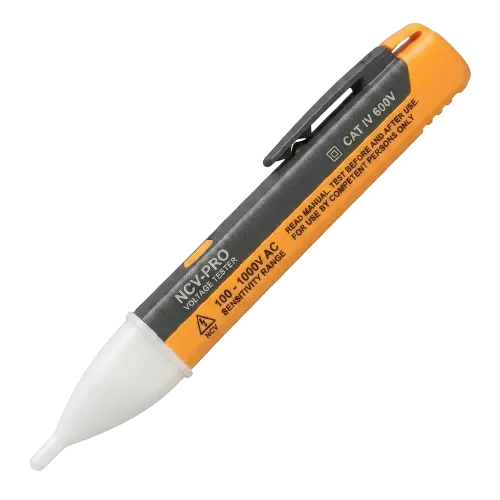
Before you touch any wire or replace a socket in your UK home, you must be certain the power is off. A Non-Contact Voltage (NCV) detector pen is your first line of defence, allowing you to check for live AC voltage through insulation without direct metal-to-metal contact.
Why use an NCV Pen?
Commonly known as a "volt stick," these tools detect the electrostatic field around live AC cables. They are indispensable for:
- Safety First: Confirming a circuit is dead after switching off the consumer unit.
- Quick Diagnostics: Finding breaks in cables or checking if a socket is energised.
- Ease of Use: No need to strip wires—the pen glows or beeps near live voltage.
Essential Safety Features
In the UK, electrical safety is governed by strict standards. When buying a voltage pen, look for these markers:
Where to Buy NCV Pens in the UK
For a reliable tool, expect to pay £12 to £30. Professional brands like Fluke, Kewtech, and Klein offer the best reliability for home use.
| Retailer | Stock Status | Recommended Model | Link |
|---|---|---|---|
| Screwfix | In Stock | LAP AC Non-Contact | View at Screwfix |
| Toolstation | Available | TIS Voltage Tester | Check Price |
| Amazon UK | In Stock | Klein Tools NCVT2P | View on Amazon |
How to Use Your Voltage Pen Safely: The "Prove-Test-Prove" Method
Using a voltage pen is simple, but it is not a "fire and forget" tool. Because NCV pens rely on capacitive coupling, they can occasionally give false negatives if the wire is too deep or the batteries are low. Following this professional safety protocol is vital for UK home DIY:
1. Prove the Pen (The Calibration Check)
Before testing the circuit you intend to work on, test the pen against a known live source. A standard 13A wall socket that is switched on and currently powering a lamp or appliance is perfect. This confirms the internal sensor, the LED indicator, and the batteries are all functioning. If it doesn't glow or beep here, stop immediately and check the batteries.
2. Safe Isolation & The Test
Isolate the circuit at the consumer unit (fuse box) and lock it if possible. Bring the tip of the pen within 5-10mm of the wire or insert it into the "Live" (right-hand) slot of the socket.
Note: In the UK, wires are often tucked deep behind plasterboard or inside metal back-boxes which can "shield" the electric field. Always test multiple points along a cable to ensure a clear reading.
3. Prove the Pen Again (Crucial)
This is where many DIYers fail. Immediately return to your known live source and test the pen again. This confirms that the pen didn't coincidentally fail or run out of battery during your actual test. Professional electricians call this "Prove-Test-Prove", and it is the only way to be 100% certain that a "dark" pen actually means a "dead" circuit.
4. Adjusting for Sensitivity & Ghost Voltages
Many modern pens have a "High/Low" sensitivity mode.
- High Sensitivity (12V-48V): Useful for finding breaks in cables or checking low-voltage lighting.
- Standard Sensitivity (100V-1000V): Use this for standard UK 230V mains testing to avoid "ghost" readings from adjacent live circuits in a crowded junction box.
5. The "Holding the Cable" Trick
Because NCV pens detect a field relative to earth, your own body acts as the ground. If you are standing on a fibreglass ladder or wearing thick rubber-soled boots, the pen might be less sensitive. Sometimes, safely touching a known earthed surface (like a metal radiator pipe) with your free hand can improve the accuracy of the pen's detection.
💡 Important NCV Limitations
- Shielded Cables: NCV pens cannot detect voltage through metal conduit or armoured (SWA) cable.
- DC Voltage: These pens are designed for AC only. They will not work on car batteries or DC solar circuits.
- False Negatives: Dirt, moisture, or holding the pen too far from the wire can lead to a false "dead" reading. Always use a contact multimeter for final verification on complex jobs.