Socket Tester Lights Meaning: How to Read the Results
A 13A plug-in socket tester is a vital safety tool for any UK home — but only if you can read what it's telling you. Plug it in and it checks in seconds whether your wall socket is wired correctly, using a pattern of lights. This guide explains what those lights mean, how to test safely, and — just as importantly — what a cheap tester can't tell you.
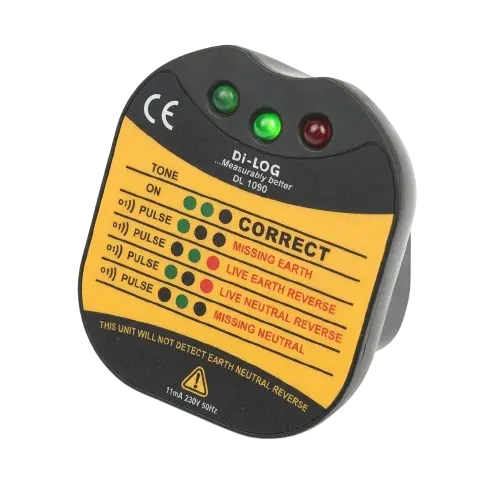
What a Socket Tester Checks
A plug-in tester (like the Di-LOG DL1090) spots wiring errors that could cause shocks or fires. It checks for:
- Correct wiring: Confirms live, neutral and earth are in the right place.
- Missing earth: Detects if the vital safety earth is disconnected.
- Reversed polarity: Flags if live and neutral are swapped — highly dangerous.
What the Socket Tester Lights Mean
Every tester has its own key printed on the front, and light colours and positions vary by model — so always check against your own device's chart. That said, most standard UK three-light testers follow this pattern:
| Result | What It Means | Action |
|---|---|---|
| Correct pattern (all expected lights on) | Live, neutral and earth all wired correctly | Safe to use |
| No earth | Safety earth missing or broken — fault could make metal parts live | Stop using; call an electrician |
| Reversed polarity (live-neutral reverse) | Live & neutral swapped — socket stays live even when switched off | Stop using; call an electrician |
| Live-earth reversed | Live & earth swapped — exposed metal can become live (shock risk) | Stop immediately; isolate circuit |
| No lights at all | No power reaching the socket (or it's switched off) | Check switch / consumer unit |
Note: basic testers can't detect an "earth-neutral reversal," and light layouts differ between brands — the printed chart on your tester is the definitive key.
When to Use a Socket Tester
A tester is the first step in diagnosing electrical issues before calling a pro.
How to Use Your Tester (Step by Step)
Don't just plug it in and hope. Follow these steps for an accurate reading.
Unplug High-Power Gear
Unplug the kettle, toaster or electric heaters on that circuit first. High-draw appliances can mask a poor neutral connection, giving a false pass.
Switch Off First
With the wall switch OFF, push the tester in firmly, then switch it ON. This avoids the little spark you sometimes get plugging into a live socket.
Check Against the Chart
Every tester is different — read the lit lights against the chart on the front. On a standard UK tester, the full correct pattern means safe; a red light or pulsing beep means a fault (see the table above).
One Socket or All of Them?
If you find a fault, test every other socket in the room. Just one faulty socket points to a loose wire in that backbox; all of them points to a bigger issue at the consumer unit.
Reality Check: What It Can't Tell You
These ~£15 testers are great for a quick check, but they aren't foolproof. They confirm a wire is in the right place, but can't tell you if your cables are old and crumbling, or whether the earth is actually strong enough to protect you in a fault (that needs an electrician's earth loop impedance test). If the tester says "fault," stop using that socket and call a pro. Pair it with a voltage detector pen and multimeter for deeper checks.
Where to Buy a Reliable Socket Tester
13A plug-in testers are stocked at most UK trade and DIY retailers. Look for the UKCA or CE mark so the device meets British safety standards.
| Retailer | Stock Status | Benefit | Link |
|---|---|---|---|
| Screwfix | In Stock | Reliable Di-LOG & LAP brands | View Product |
| Toolstation | Available | Budget-friendly DIY tools | Check Price |
| Amazon | In Stock | Masterplug & other models | View Details |
💡 Pro Safety Tips
- Know your beeps: Some models beep continuously for "correct" and pulse for "fault" — always check your manual.
- Don't leave it plugged in: It's a diagnostic tool, not a permanent monitor. Unplug after testing.
- "Correct" isn't a certificate: A pass doesn't guarantee the installation is 100% safe (it can't check wire degradation), but it's a vital first check.
Frequently Asked Questions
What do the lights on a socket tester mean?
Each tester has its own printed key, but generally the full "correct" pattern means the socket is wired properly, while other combinations flag a fault like no earth or reversed polarity. Always read against your own tester's chart, as colours and positions vary.
What does "no earth" mean on a socket tester?
The safety earth connection is missing or broken. Without it, a fault could leave metal parts live — stop using the socket and get an electrician to investigate.
What is reversed polarity on a socket?
Live and neutral are connected the wrong way round, so the socket stays live even when switched off. An appliance can remain energised when you think it's safe — it needs correcting by an electrician.
Are socket testers reliable?
They reliably spot common errors like missing earth and reversed polarity, but can't confirm full safety — they don't measure earth loop impedance or detect degraded cables, and can miss an earth-neutral reversal. Treat "correct" as reassuring, not a certificate.
How do I use a socket tester?
Unplug high-power appliances, push the tester in with the switch off, then switch on and read the lights against the chart. If it shows a fault, test the other sockets to see if it's one socket or the whole circuit.
What should I do if it shows a fault?
Stop using that socket, and switch off the circuit at the consumer unit for serious faults like missing earth or reversed polarity. Testers identify faults; repairs must be done by a qualified electrician.