What Pressure Should My Boiler Be? UK Guide to Bar Levels (Cold vs Hot)
For most UK combi boilers, the correct pressure is 1.0–1.5 bar when the system is cold and 1.5–2.5 bar when the heating is running. Below 0.5 bar the boiler will lock out with a fault code. Above 3.0 bar the pressure relief valve activates. Always check your boiler manual for model-specific ranges.
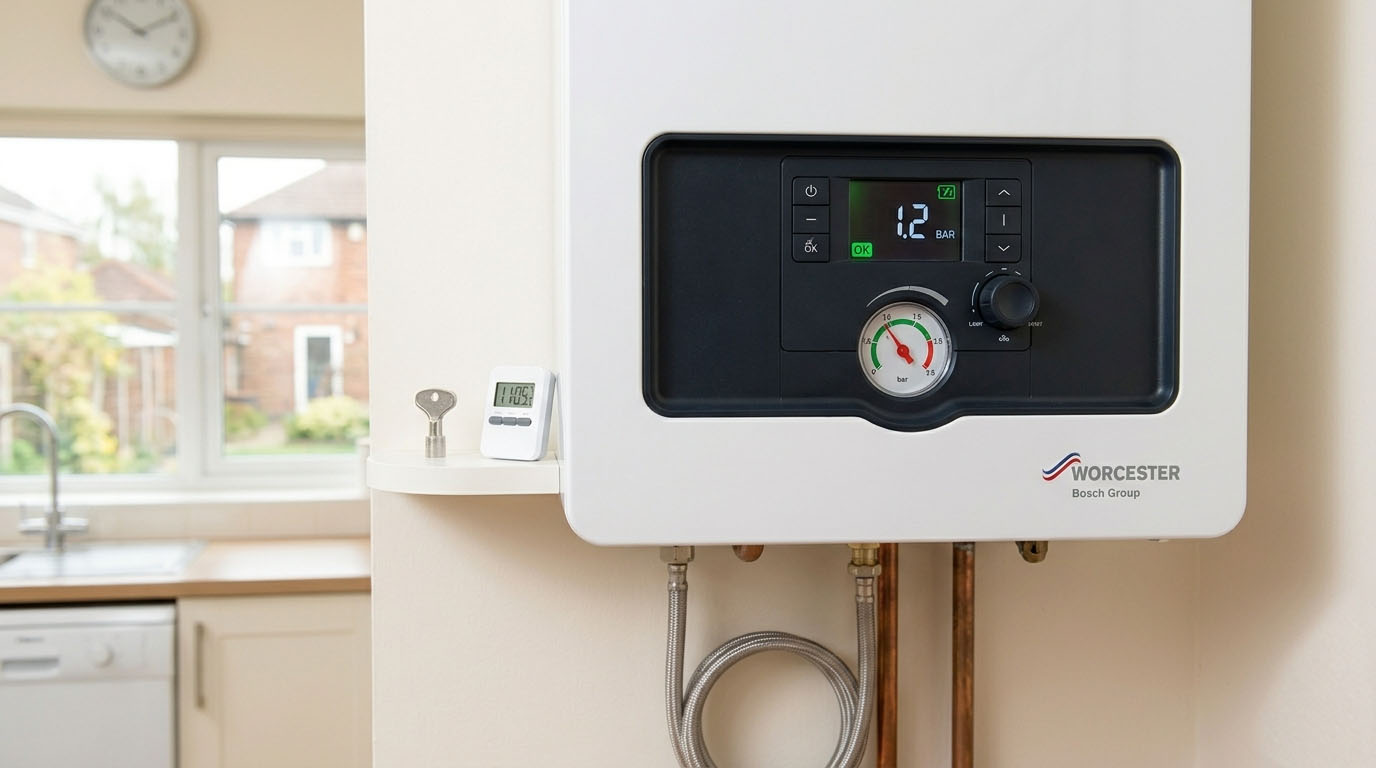
Have you noticed your radiators aren't getting quite as warm as they used to, or perhaps your central heating has completely shut down? Nine times out of ten, the culprit is incorrect water pressure. Keeping your central heating system filled to the right bar level is vital to stay warm, cut energy bills, and avoid expensive breakdowns.
Whether you have a Worcester Bosch, Vaillant, Baxi, or Ideal combi boiler, they all rely on standard pressurised water loops to operate. This guide covers exactly what bar your boiler should sit at when cold versus hot, how to troubleshoot fluctuating readings, and how to top up the system yourself without calling an engineer.
Quick Navigation
1. The Ideal Boiler Pressure Levels (Cold vs Hot)
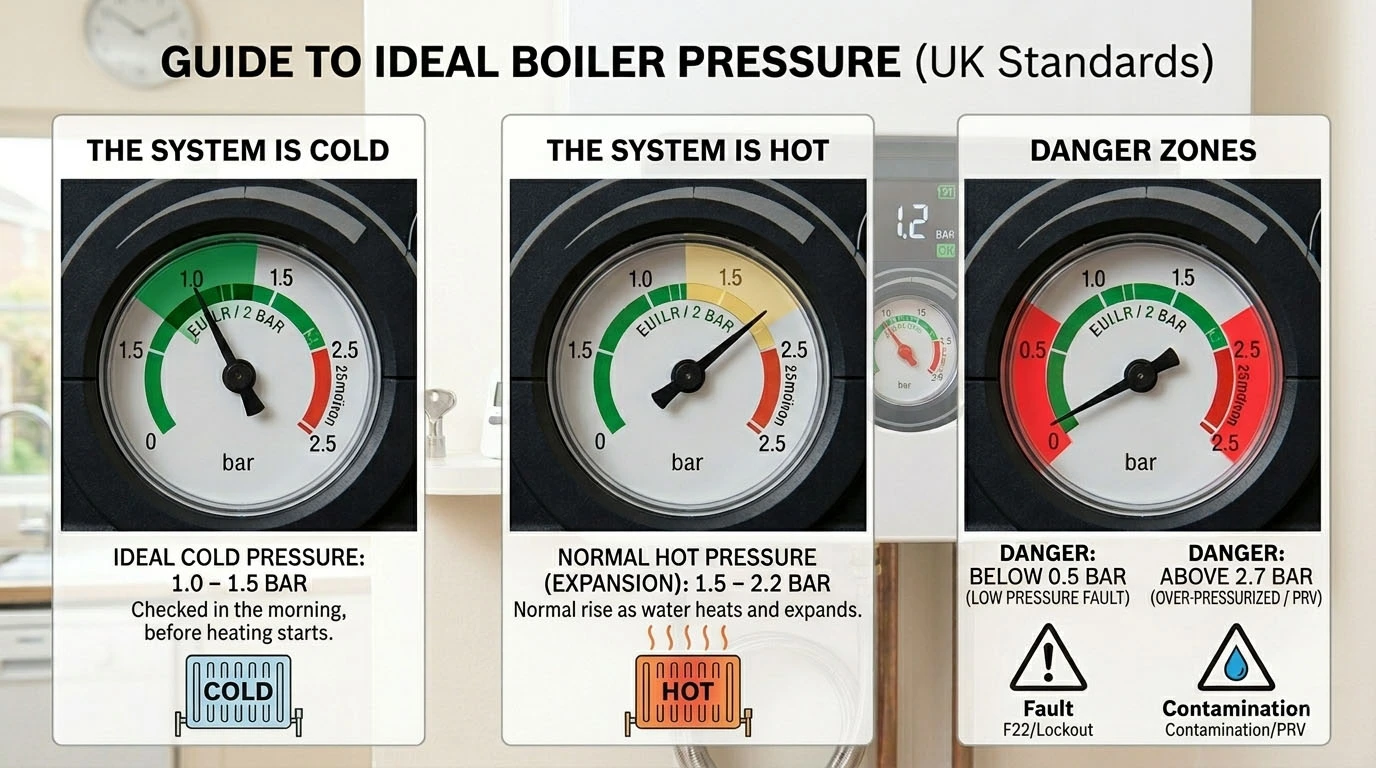
Your boiler's water pressure is measured in "bar" using a small pressure gauge — either a mechanical dial with a needle or a digital readout on the LCD panel. Most gauges use a colour-coded zone layout: red below 0.5 bar, green between 1.0 and 2.5 bar, and red again above 3.0 bar. If the display goes blank entirely rather than showing a pressure reading, that points toward a broader thermostat fault or a control PCB failure rather than a pressure issue.
Pressure Zones Explained
- Cold system (ideal: 1.0–1.5 bar): Check this in the morning before your programmer kicks in. The needle should sit comfortably inside the green band. Most engineers set new installations to 1.2–1.3 bar cold.
- Hot system (normal: 1.5–2.5 bar): As water heats up inside the heat exchanger it expands. Your system has an expansion vessel to absorb this, but the gauge will still rise by roughly 0.3–0.7 bar from its cold reading. This is completely normal.
- Danger zones (below 0.5 bar or above 3.0 bar): Below 0.5 bar the low pressure safety cut-out will lock the boiler out — commonly triggering a boiler not firing up error. Above 3.0 bar the pressure relief valve will dump water outside through a copper discharge pipe.
Recommended Pressure by Boiler Brand (UK)
While the 1.0–1.5 bar cold rule applies to most UK boilers, manufacturers publish their own recommended ranges. Here's a quick reference:
| Boiler Brand | Cold Pressure | Hot Pressure | Low Pressure Error Code |
|---|---|---|---|
| Worcester Bosch | 1.0–1.5 bar | 1.5–2.0 bar | EA 338 / E9 |
| Vaillant ecoTEC | 1.0–1.5 bar | 1.5–2.0 bar | F.22 |
| Baxi | 1.0–1.5 bar | 1.5–2.0 bar | E168 / 118 |
| Ideal Logic | 1.0–1.5 bar | 1.5–2.5 bar | F1 |
| Viessmann Vitodens | 1.2–1.8 bar | 1.8–2.5 bar | F4 |
| Alpha | 1.0–1.5 bar | 1.5–2.0 bar | E10 |
Always cross-check against your specific model's manual — error codes can vary between generations of the same brand.
2. Signs & Causes of Low Boiler Pressure
If your system drops below the safe pressure threshold, you will usually notice performance problems long before the boiler actively locks out with an error code.
The most common symptoms include:
- Radiators warm at the bottom but cold at the top. If this persists even after topping up, you may have a separate issue with cold downstairs radiators caused by sludge or imbalanced system flow.
- A faint trickling or dripping sound inside the boiler casing, which can develop into a noticeable boiler vibrating noise if air cavities form around the pump.
- The boiler cutting out unexpectedly or displaying a low pressure warning such as F22, EA 338, or F1 depending on your make.
Why Is My Boiler Losing Pressure?
Central heating systems are sealed loops — water shouldn't disappear. A pressure drop is almost always caused by one of two things:
- Recent radiator bleeding: When you use a radiator key to release trapped air, you lose system volume. If the radiator is still cold at the top after bleeding, it usually means the lost air volume has pulled the baseline pressure down. You need to replace it with fresh mains water using the filling loop.
- A hidden leak: If you keep asking yourself why boiler pressure drops overnight, even a tiny pinhole leak behind skirting boards, under floorboards, or at radiator valve joints can bleed the system down over days. Check for damp patches and water stains around pipework.
3. How to Top Up Your Boiler Pressure Safely
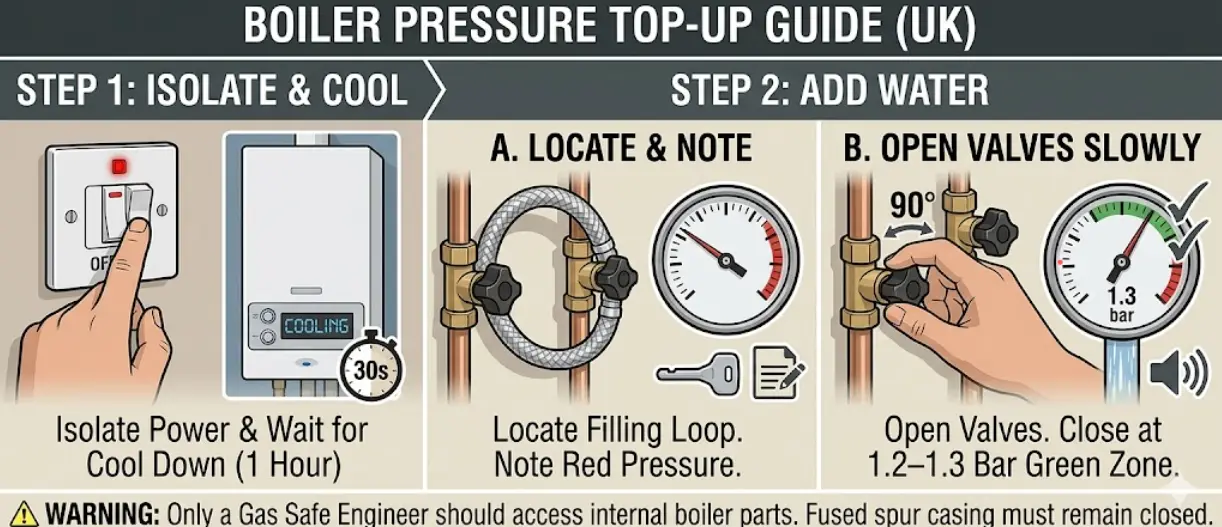
If your pressure needle is sitting below 1.0 bar, you don't need to panic or book an expensive engineer callout. Topping up takes about 10 minutes and uses a component underneath your boiler called the filling loop.
Most UK combi boilers — Worcester Bosch, Baxi, Vaillant, Ideal — work the same way: the filling loop connects a mains cold water pipe to your sealed central heating circuit. Opening the valves lets fresh water in until the system reaches the correct operating pressure.
What You'll Need
- Access to the area beneath your boiler (usually a kitchen cupboard)
- A dry cloth or small towel
- A torch if the cupboard is dark
- 1–2 minutes of patience while the pressure rises
Step-by-Step: Repressurising Your Boiler
-
Switch off and let the system cool (30–60 minutes)
Turn your central heating and hot water off at the programmer or control panel, then flick the boiler off at the fused spur wall switch. Wait at least 30 minutes — ideally an hour — for the system to cool completely. Filling a hot pressurised circuit with cold mains water causes thermal shock and can crack the heat exchanger, which is a costly repair. -
Locate the filling loop beneath the boiler
Open the cupboard or access panel below the boiler casing. You're looking for a short, flexible braided metal hose (silver or grey) connecting two copper pipes — each pipe has a small black tap handle. On some Worcester Bosch and Vaillant models there's an internal plastic key that slots into a recessed port on the boiler body instead of an external hose. If you're unsure, check your boiler manual or search your model number online. -
Take note of the current pressure reading
Check the pressure gauge — either a round analogue dial or a digital readout on the display panel. The needle should be in the red zone below 1.0 bar. Note exactly where it sits so you can track how quickly the pressure rises. -
Open the filling loop valves slowly
Turn one or both black valve levers 90 degrees until they run parallel with the pipework. You'll hear a rushing or hissing sound — that's cold mains water entering the sealed circuit, and it's completely normal. Some loops have two valves (open both); others have just one. If a valve feels stiff and won't turn: stop. Don't force it — call a Gas Safe engineer rather than risk snapping the fitting. -
Watch the gauge and stop at 1.2–1.3 bar
Keep your eyes on the gauge. The needle will rise steadily into the green zone. The moment it hits 1.2–1.3 bar, close both valve levers back to their original position (perpendicular to the pipes). Don't overfill — above 2.5 bar the pressure relief valve will start venting water outside, and above 3.0 bar you'll need to bleed a radiator or call an engineer to bring it back down. -
Wipe down and check for drips
Run a dry cloth along the filling loop hose and both valve fittings. Any drips at the connections mean the valve isn't fully closed — give it another quarter turn. Persistent dripping means the valve seat is worn and needs replacing by a Gas Safe engineer. -
Restore power and test the heating
Switch the boiler back on at the fused spur, set a heating demand on the thermostat or programmer, and wait for the first heat cycle to complete. Check the gauge once the system is warm — it should read around 1.8–2.0 bar under load, which is normal. If it immediately drops back below 1 bar, you have a leak or a faulty pressure relief valve that needs professional attention.
How Often Should You Need to Top Up?
A well-maintained sealed system should hold its pressure for several months. If you're topping up more than two or three times a year, that's a sign of an underlying problem — a slow leak at a radiator valve, a corroded pipe joint, or a weeping pressure relief valve. Don't just keep topping up: call a Gas Safe registered engineer to diagnose the root cause.
4. What to Do If Boiler Pressure Is Too High
If your pressure gauge sits above 2.5 bar when cold, or peaks near 3.0 bar while heating is running, your system is overfilled. This puts strain on internal seals, the pump, and pipe joints throughout your home.
When a boiler is over-pressurised, a safety device called the Pressure Relief Valve (PRV) activates and vents excess hot water outside through a small copper pipe that exits through the external brickwork. If you notice this pipe dripping or running continuously outside your home, your pressure is too high.
How to Lower High Boiler Pressure Yourself
The simplest DIY fix is to bleed your radiators. Attach your radiator bleed key to the valve on a convenient radiator, hold a cloth underneath, and open the valve slightly. Let water trickle out for 15–30 seconds — this removes volume from the closed loop and slowly drops the main pressure gauge back into the safe 1.0–1.5 bar green zone. Check the gauge between bleeds so you don't go too far and end up with low pressure instead.
If bleeding doesn't bring it down, or it climbs back above 2.5 bar repeatedly, the expansion vessel has likely failed and lost its internal air charge. That requires a Gas Safe engineer to diagnose and repair.
5. Common Boiler Pressure Fault Repair Costs (UK 2026)
Most pressure issues start as a simple free top-up job. But if there's an underlying fault, here's what you can expect to pay a Gas Safe engineer in the UK in 2026, including parts and labour:
| Fault | Typical UK Cost (2026) | DIY Possible? |
|---|---|---|
| Top up pressure via filling loop | Free — DIY | ✅ Yes |
| Replace worn filling loop valve | £80–£150 | ⚠ Gas Safe only |
| Recharge or replace expansion vessel | £150–£300 | ⚠ Gas Safe only |
| Replace pressure relief valve (PRV) | £120–£250 | ⚠ Gas Safe only |
| Trace and repair a hidden pipe leak | £200–£600+ | ❌ No |
| Replace heat exchanger (thermal shock damage) | £400–£900+ | ❌ No |
Prices are estimates based on average UK engineer call-out and parts costs in 2026. Always get at least two quotes from Gas Safe registered engineers.
Questions & Answers
Real questions from homeowners — answered by our team.
Community Questions
Boiler Pressure FAQs
What happens if my boiler pressure is at 2 bar?
If your boiler pressure is at 2 bar while the heating is actively running and warming your home, this is completely normal. However, if the gauge reads 2 bar when the system is completely cold, it is slightly above the recommended 1.0–1.5 bar baseline. Keep an eye on it to ensure it doesn't climb further toward the 3 bar danger zone when the heating kicks in.
Is it safe to run a boiler with low pressure?
Generally yes — modern boilers have built-in safety cut-outs. If pressure drops below 0.5 bar, the boiler will display a fault code and shut itself down to prevent internal damage. It won't be dangerous, but you'll be without hot water and heating until it's topped up using the filling loop.
Why does my boiler pressure keep dropping every day?
If you're topping up pressure every few days, you have a problem that needs investigating. The most common causes are a hidden water leak somewhere along the central heating pipework, or a failed internal expansion vessel that has lost its air charge — forcing the safety valve to vent water outside. Call a Gas Safe engineer to find the root cause rather than continuing to top up.
Can I use my boiler while the filling loop is connected?
No. The filling loop valves should only ever be opened to top up the system and must be tightly closed immediately afterward. Leaving a filling loop open means your heating circuit stays connected to the mains water supply. This will overfill the system, blow the safety valve, and could potentially contaminate your home's drinking water supply through back-flow.
Do I need a Gas Safe engineer to fix low boiler pressure?
Not for a routine top-up — that's a straightforward DIY job any homeowner can do safely using the filling loop. However, if your boiler needs parts replacing (pressure relief valve, expansion vessel, or filling loop valve), or if you can't find the source of a continuous pressure drop, you must use a registered Gas Safe engineer. It's illegal for unregistered individuals to work on gas appliances in the UK.
What is a normal boiler pressure for a Worcester Bosch?
Worcester Bosch combi boilers should sit between 1.0 and 1.5 bar when cold, rising to around 1.5–2.0 bar once the heating is running. If the pressure drops below 1.0 bar, a Worcester Bosch will typically display an EA 338 or E9 low pressure error code and lock out until you top it up.
What should Vaillant boiler pressure be?
Vaillant ecoTEC boilers should read 1.0–1.5 bar when the system is cold. During normal heating operation, expect the gauge to rise to around 1.8–2.0 bar. If pressure drops below 0.8 bar, a Vaillant will display an F.22 fault code. Top up using the filling loop until the gauge reads 1.2–1.3 bar, then restart the boiler.