Boiler Making Vibrating Noise When Heating is On? UK Fixes
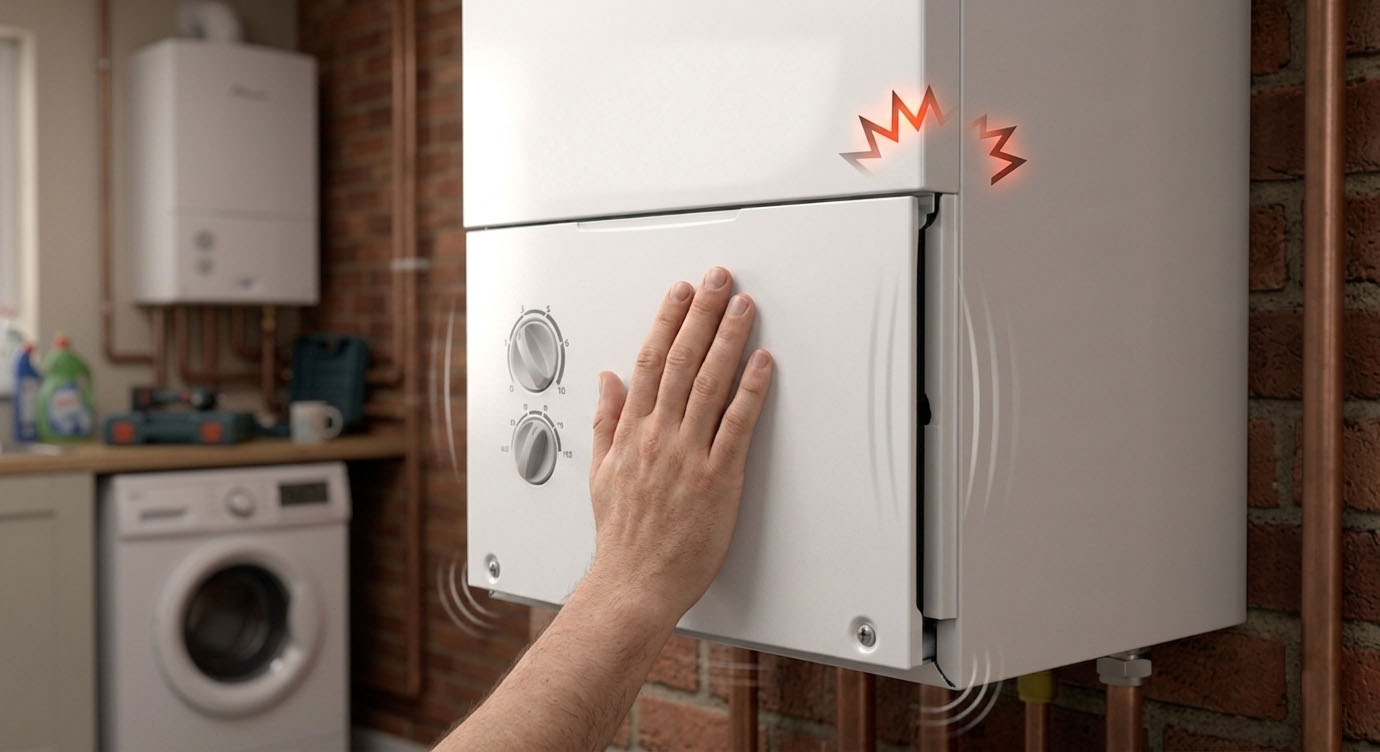
Is your boiler making a loud vibrating noise every time the central heating kicks in? It can be an alarming sound sometimes described as a deep hum, a rattle, or even a "drone" that resonates through the walls of your home.
While most UK boilers like Worcester Bosch, Vaillant, or Ideal are designed to run quietly, a vibration usually signals that a mechanical component is struggling or something has shaken loose. In this guide, we’ll break down what you can check yourself and when you need to call a Gas Safe expert.
Quick Navigation
1. Loose Casing, Screws, or Brackets
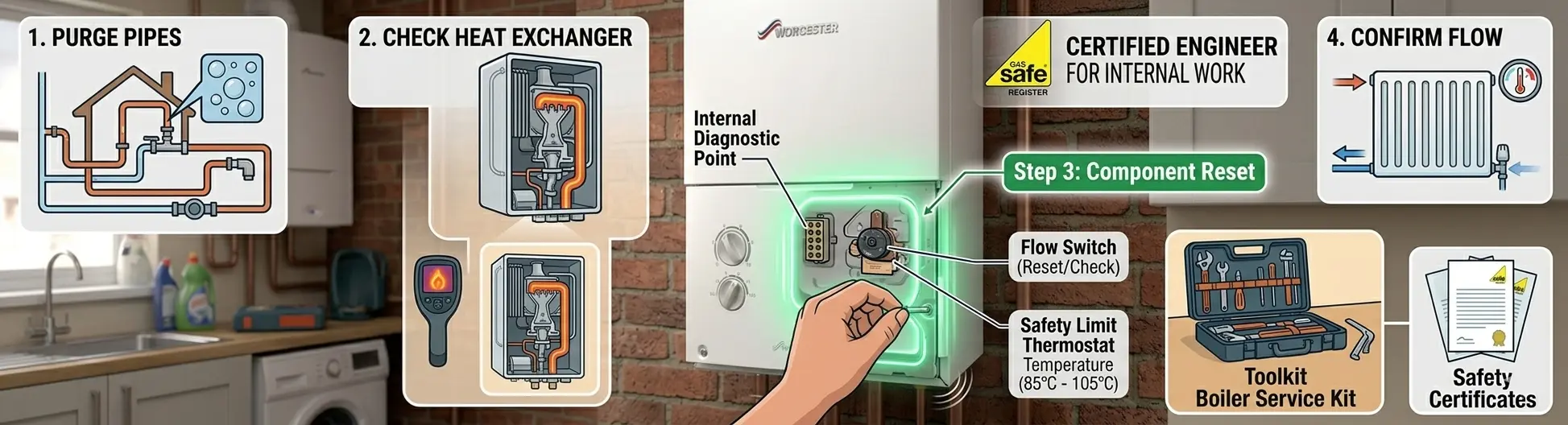
The most common cause of a vibrating boiler is also, fortunately, the least dangerous. All modern boilers contain high-speed moving parts, specifically the central heating pump and the extractor fan. These components naturally create micro-vibrations.
Normally, the boiler casing is seated correctly, absorbing these vibrations. However, if a casing screw wasn't tightened fully during the last service, if a plastic clip has snapped, or if the boiler wasn't mounted flush against the wall bracket, these micro-vibrations turn into a loud, resonating rattle.
How to Check and Fix Casing Noise:
- The Press Test (Animated Above): While the boiler is vibrating, locate the noise source. Gently but firmly press your hand against the front panel, and then the side panels. If the noise stops or significantly reduces in pitch, you have confirmed the issue is external casing resonance.
- The Screwdriver Fix: Check the visible screws, usually located at the very bottom or top of the front panel. Use the correct screwdriver (often a PZ2 or Torx) and ensure they are snug. **Do not over-tighten, as you may strip the thread.**
- The Bracket Check: Carefully look behind the boiler where it meets the wall. If you see a gap or if the boiler moves slightly when pressed, the mounting bracket is loose. This requires a professional to secure, as the boiler must be unmounted.
2. Pump Cavitation or Bearing Failure
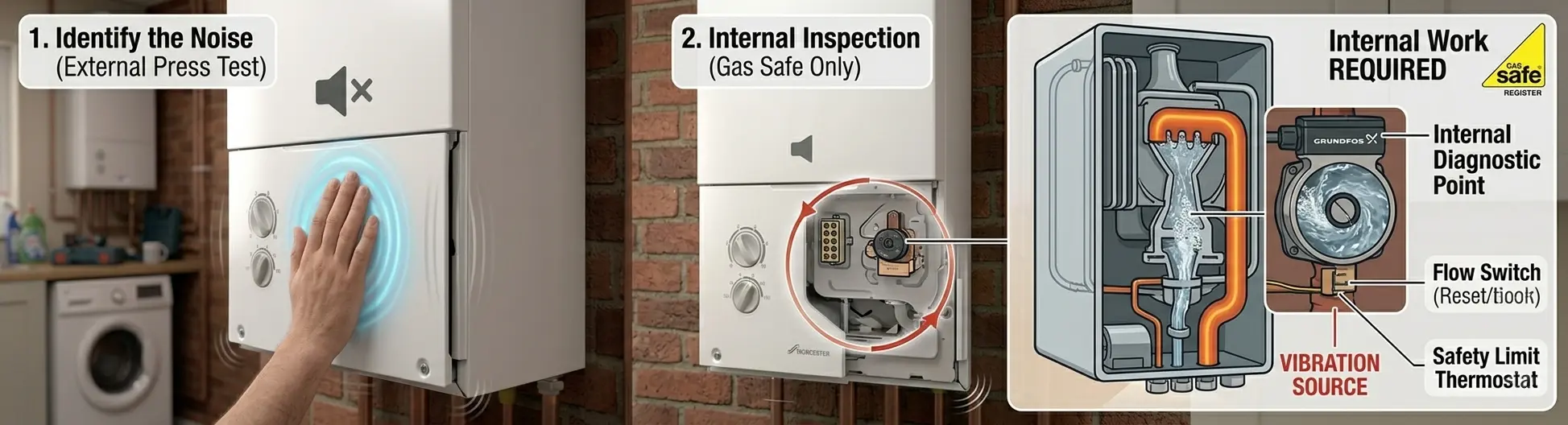
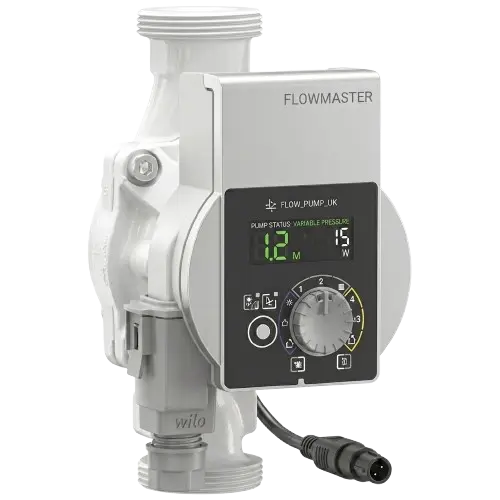
If your boiler is making a constant, deep humming vibration that resonates through your pipes, the culprit is almost certainly the circulation pump. The pump (see the animation above) is responsible for pushing hot water around your radiators. It uses a high-speed impeller balanced on bearings.
There are two distinct ways a pump causes vibration:
- Pump Cavitation (Shown in Animation): If your system pressure is too low (check your bar gauge!) or if air is trapped in the system, tiny air bubbles form inside the pump housing. These bubbles collapse violently (cavitate) against the impeller. This creates a distinctive, noisy vibration and erodes the pump internally.
- Bearing Wear: Over years of constant use, the bearings supporting the impeller shaft wear down. This causes the shaft to oscillate, creating a loud, consistent mechanical drone or vibration that increases with the pump speed setting.
How to Address Pump Vibration:
- Check System Pressure (DIY): Ensure your boiler pressure gauge is between 1.0 and 1.5 bar. If it is low, top it up using the filling loop. This is the simplest fix for cavitation vibration.
- Bleed the Radiators (DIY): Air trapped anywhere in the system can find its way to the pump. Bleeding all radiators can often purge the air causing cavitation.
- Bleed the Pump (Engineer Only): Many UK pumps have a small silver screw on their face. A Gas Safe engineer can slightly loosen this to release trapped air directly from the pump housing while the system is running. **Do not attempt this as hot water can spray out.**
3. Unbalanced or Dirty Extractor Fan
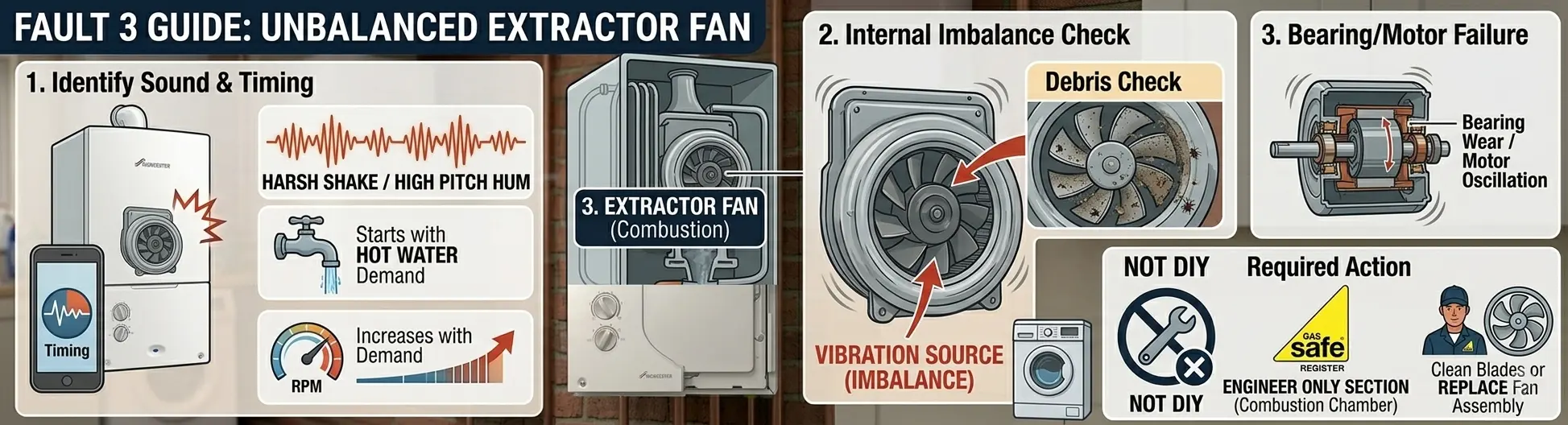
If the vibrating noise starts immediately when you turn on a hot tap (even before the heating is active), and it increases in pitch and volume the harder the boiler works, the cause is likely the extractor fan.
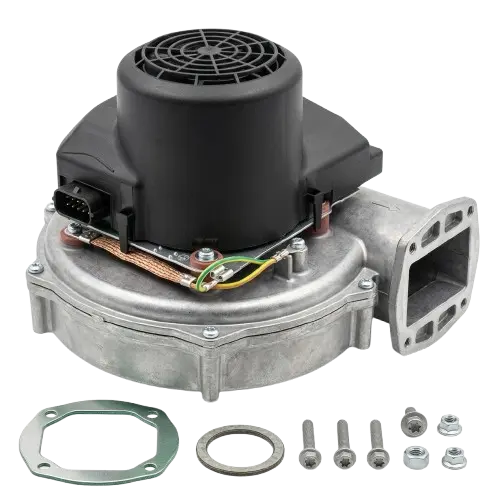
The fan (visualized above) has a crucial job: it pulls fresh air in for combustion and pushes the dangerous waste gases out through the flue. It operates at incredibly high RPM. Like a car wheel or a washing machine drum, the fan *must* be perfectly balanced.
Why Fans Cause Violent Vibrations:
- Debris Build-up: In the UK, small insects, dust, or even tiny pieces of rust from the heat exchanger can get pulled into the fan housing. If even a few grams of debris settle on a single fan blade, the massive centrifugal force at high RPM creates a severe imbalance. This forces the entire fan assembly to wobble, shaking the entire chassis of the boiler.
- Bearing Failure: Like the pump, the fan motor has bearings. If these fail, the fan shaft will vibrate severely, often making a high-pitched screaming or grinding noise alongside the vibration.
An engineer will be able to diagnose this quickly. They will remove the fan assembly, clean the blades meticulously, or replace the entire unit if bearing wear is detected.
Typical Repair Costs (UK 2026)
Repairing a vibrating boiler in the UK typically involves a combination of diagnostic fees, replacement parts, and labour charges. While simple fixes like tightening a casing bracket are cheap, complex internal repairs such as replacing a fan or pump require a Gas Safe registered engineer.
Prices vary depending on your location (London and the South East are usually 20%–30% higher) and the specific make and model of your boiler.
| Product Image | Part Details | Estimated Cost (Fixed) | Action |
|---|---|---|---|
|
Circulation PumpGrundfos or Wilo compatible pumps |
£180 - £350 | View Parts |
|
Internal Fan UnitSpecific to your boiler model |
£220 - £300 | View Parts |
Vibrating Boiler & Noise FAQs
Why is my boiler making a vibrating noise and then locking out?
This is often a safety feature. If the internal fan is unbalanced or the pump has seized, the boiler will detect that it cannot safely exhaust gases or move heat away from the heat exchanger. It will display a fault code (like F22 or E119) and "lockout" to prevent damage.
Why can I hear vibrating under the floorboards when the heating is on?
This is usually "thermal expansion" or "pipe chatter." As hot water travels through your UK central heating system, the copper pipes expand and rub against floor joists. If the pipes aren't clipped properly, they will vibrate and rattle.
What is 'Kettling' and does it cause vibration?
Kettling sounds like a whistling kettle and often causes the boiler to shake. It happens when limescale or sludge builds up on the heat exchanger, restricting water flow and causing it to overheat and bubble rapidly.
Can a magnetic filter stop boiler vibrations?
Indirectly, yes. A magnetic filter removes 'magnetite' (sludge) from your system. Without a filter, this sludge can clog your pump or heat exchanger, leading to the cavitation and kettling vibrations discussed in this guide.
Should I turn my boiler off if it starts vibrating loudly?
If the vibration is severe enough to shake the casing or is accompanied by a burning smell or unusual banging, you should turn it off at the fused spur. It is always better to be safe and have a Gas Safe engineer inspect the internal fan or pump.