Best Boiler Pressure in the UK: Ideal Range Explained (2026)
Quick Navigation
What Is the Ideal Boiler Pressure for a UK Home?
The simple answer: 1–1.5 bar when the system is cold, rising to 1.5–2 bar when the heating is on. Most UK heating engineers aim for around 1.2–1.3 bar as a resting pressure — high enough to circulate properly, low enough to give headroom as the system heats up.
A rise of 0.3–0.5 bar when the boiler fires up is completely normal. Water expands as it heats, so the pressure naturally increases. As long as the hot-running pressure stays below 2.5 bar, there is nothing to worry about. If you notice your gauge dropping off dramatically overnight when the heating cools, see our diagnostic breakdown on why boiler pressure drops overnight.
These figures apply to sealed central heating systems — the type found in the vast majority of UK homes with combi or system boilers. If you have an older open-vented system with a header tank in the loft, it works on a completely different principle and does not have a pressurised gauge to monitor.
How to Read a Boiler Pressure Gauge
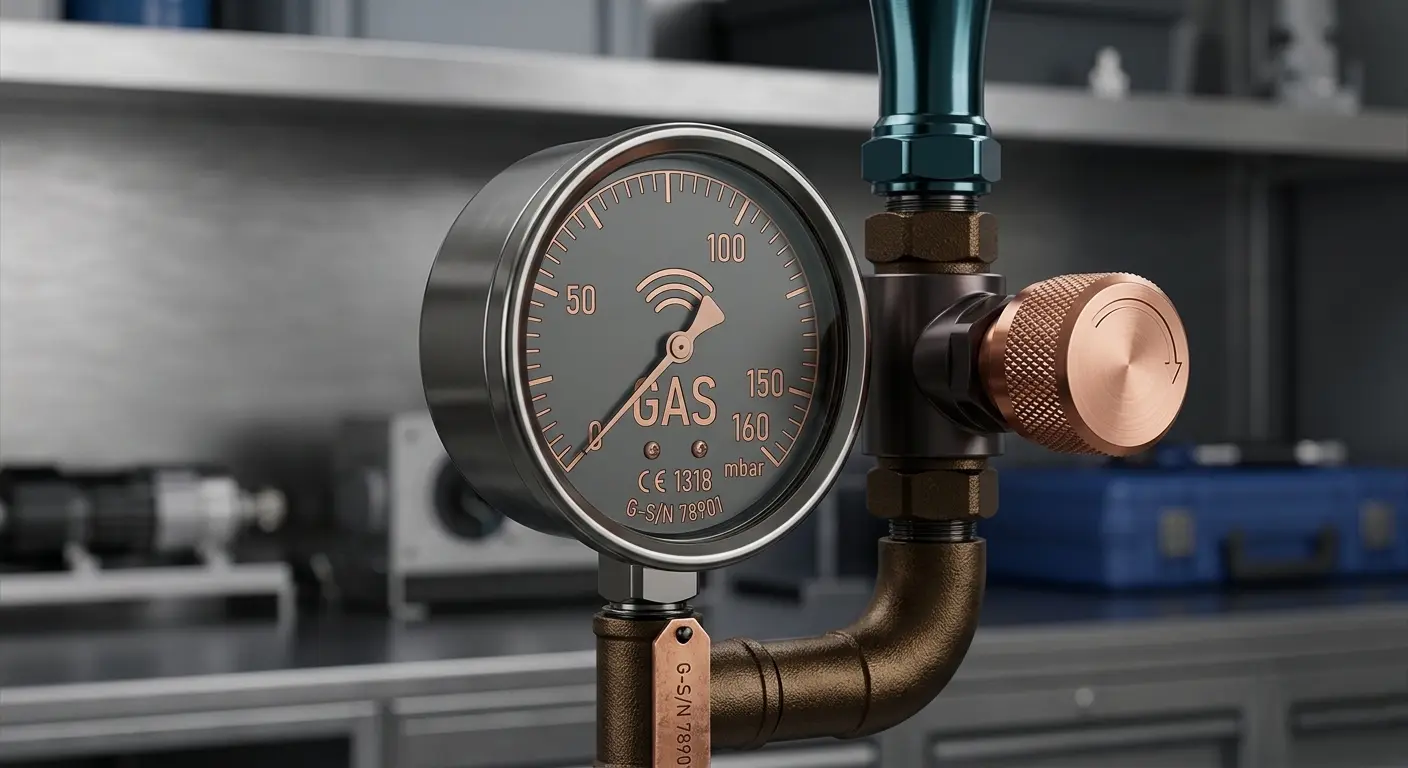
Most UK boilers have either a needle dial gauge or a digital pressure readout on the front panel. Both show pressure in bar. On a needle gauge, look for a green zone — this is the manufacturer's safe range, usually marked between 1 and 2.5 bar. Red zones either side warn you when pressure is dangerously low or high. If your gauge looks normal but your heating system isn't firing up, check out our guide on troubleshooting a boiler not firing up.
The best time to check pressure is when the heating has been off for at least an hour and the system is fully cold. This gives you the resting pressure, which is what you compare against the 1–1.5 bar ideal.
Recommended Boiler Pressure by Brand (UK)
Most UK boiler manufacturers recommend similar pressure ranges, but there are slight differences. Always check your boiler's manual — this table gives you a quick reference for the most common brands.
| Brand | Ideal Cold Pressure | Normal Hot Pressure | Max Safe Pressure | Notes |
|---|---|---|---|---|
| Worcester Bosch | 1.0–1.5 bar | 1.5–2.0 bar | 3.0 bar | Greenstar models show F… fault codes for low pressure |
| Vaillant | 1.0–1.5 bar | 1.5–2.0 bar | 3.0 bar | ecoTEC series locks out at below 0.5 bar (F.22) |
| Baxi | 1.0–1.5 bar | 1.5–2.0 bar | 3.0 bar | E119 low pressure fault code common on older Baxi 100 |
| Ideal | 1.0–1.5 bar | 1.5–2.0 bar | 3.0 bar | Logic+ models display F1 for low pressure |
| Viessmann | 1.0–1.5 bar | 1.5–2.0 bar | 2.5 bar | Vitodens 100 has a lower max threshold than most brands |
| Alpha | 1.0–1.5 bar | 1.5–2.0 bar | 3.0 bar | E10 fault code indicates low water pressure |
| Glow-worm | 1.0–1.5 bar | 1.5–2.0 bar | 3.0 bar | Relies on a visible fill key; keep this stored safely nearby |
| Potterton | 1.0–1.5 bar | 1.5–2.0 bar | 3.0 bar | Similar architecture to Baxi; shares fault code terminology |
Source: individual brand installation/user manuals. Always defer to your specific model's manual for precise limits.
Low Boiler Pressure: Causes and What to Do
Low pressure — below 1 bar — is by far the most common boiler pressure complaint in UK homes. The boiler may still fire, but circulation suffers and many modern boilers will lock out and display a fault code to protect the heat exchanger.
Common causes of low boiler pressure
- A small water leak — the most frequent culprit. Check radiator valves, pipe joints under floors, and connections at the boiler itself. If you trace the leak down to a pipe setup under your kitchen sink, read our guide on how to fix a leaking pipe under a sink.
- A recently bled radiator — bleeding lets air out but also releases a small amount of water from the system, which drops the pressure slightly. If you have done this but your heating is still uneven, check what to do when a radiator is cold at the top after bleeding.
- A faulty pressure relief valve (PRV) — the PRV is a safety valve designed to open if pressure gets dangerously high. If it has opened at some point (intentionally or due to a fault), it will have released water and dropped pressure.
- A waterlogged expansion vessel — this vessel absorbs pressure increases as water heats. When it fails, it can no longer do this job and pressure swings become erratic.
What to do
If the pressure has dropped below 1 bar but the system was working fine recently, repressurising via the filling loop is a reasonable first step (see the step-by-step guide below). If it stays at the correct pressure for several weeks, the issue may have resolved itself (perhaps after radiator bleeding). If it keeps dropping, call an engineer.
High Boiler Pressure: Causes and What to Do
High pressure — above 2.5 bar cold, or above 3 bar when running — puts unnecessary stress on the system and can trigger the pressure relief valve to discharge water outside through the overflow pipe.
Common causes of high boiler pressure
- Overfilling during repressurisation — the most common cause. It is easy to go past 1.5 bar if you are not watching the gauge carefully.
- A faulty filling loop left open — if the filling loop valves are not fully closed, mains water continues to trickle into the system.
- A failed expansion vessel — when the vessel can no longer absorb expansion, hot running pressure shoots up rather than rising gradually.
What to do about high pressure
The standard fix is to bleed a radiator until the pressure drops back below 1.5 bar, then close the radiator bleed valve tightly. Do not open the bleed valve fully — a small turn is enough to let water out slowly. Watch the gauge and stop at around 1.2–1.3 bar. If you find unequal distribution across floors (such as cold ground floor rooms), our guide on dealing with cold downstairs radiators has practical system-balancing strategies.
How to Repressurise a Combi Boiler (Step-by-Step)
Repressurising a combi boiler is a job most UK homeowners can handle themselves. It does not involve the gas side of the boiler — you are simply adding cold water from the mains into the sealed heating circuit. It typically takes under 10 minutes.
What you will need: Just access to the boiler. No tools required unless your filling loop has a screwhead valve (flat-head screwdriver).
- Turn the boiler off at the programmer or thermostat and let the system cool for at least 30 minutes. Never repressurise a hot system.
- Locate the filling loop — it is a flexible silver braided hose underneath the boiler, connecting two pipes. There will be one or two small lever or screwhead valves on it.
- Open the valves slowly — turn both valves (or the single valve) carefully. You will hear water flowing into the system. Watch the pressure gauge.
- Stop at 1.5 bar — close both valves firmly the moment the needle reaches 1.5 bar. Do not overshoot. Even a few seconds too long can push pressure too high.
- Restart the boiler — switch it back on. If it locked out due to low pressure, press the reset button. Check the gauge again after the heating has been running for 10–15 minutes. Expect it to rise to around 1.8–2 bar when hot — that is normal.
When to Call a Gas Safe Engineer
Repressurising is a homeowner task. Everything else on this list is not — call a Gas Safe registered engineer:
- Pressure drops to low within a few days of topping up — suspected leak
- You cannot locate any obvious leaks but pressure keeps falling
- The overflow pipe outside the house is dripping water
- Pressure spikes above 3 bar regularly when heating is on
- The boiler fault code keeps returning after reset
- You hear unusual noises — banging, gurgling, or heavy shaking — see our manual on troubleshooting a boiler vibrating noise
- The expansion vessel may need repressurising or replacement (this requires professional equipment)
Questions & Answers
Real questions from homeowners — answered by our team.
Community Questions
Frequently Asked Questions
What should boiler pressure be when the heating is off?
When the heating is off and the system is fully cold, pressure should sit between 1 and 1.5 bar. Most engineers top up to around 1.2–1.3 bar — this gives a bit of headroom for the pressure rise when the boiler fires up.
What should boiler pressure be when the heating is on?
Normal operating pressure with heating running is 1.5–2 bar. A rise of 0.3–0.5 bar from the cold resting pressure is perfectly normal. Start to pay attention if it consistently exceeds 2.5 bar while hot.
Is 2 bar too high for a boiler?
Not when the heating is on — 2 bar during operation is completely normal. If your gauge is showing 2 bar or above when cold and the system has not been on for a while, that is slightly high and worth reducing by bleeding a radiator.
Why does my boiler pressure keep dropping?
Pressure that keeps dropping — especially more than once every few weeks — usually means there is a leak somewhere in the system, a faulty pressure relief valve, or an expansion vessel that needs attention. Repeatedly topping it up without fixing the root cause is not a solution. Get a Gas Safe engineer to investigate.
Can I repressurise my boiler myself?
Yes. Using the filling loop to top up pressure does not involve the gas side of the boiler and is safe for most homeowners to do. The process is straightforward: cool the system, open the filling loop valves, fill to 1.5 bar, close the valves. See the full step-by-step guide above.
What happens if boiler pressure is too low?
Below 1 bar, the boiler may not circulate water effectively and radiators can feel cold even when running. Many modern boilers lock out completely and show a fault code (F1, A1, E119, F.22 depending on brand) to protect internal components until pressure is restored.
What happens if boiler pressure is too high?
Sustained high pressure stresses seals and the expansion vessel. The pressure relief valve may open and discharge water through an overflow pipe — this is the boiler protecting itself. If the overflow pipe is dripping, call a Gas Safe engineer rather than trying to fix it yourself.
How often should I check my boiler pressure?
Once a month during the heating season (roughly October to March) is ideal. Outside that, a check every couple of months is sufficient unless you notice a fault code or the radiators feel less effective than usual.