Adjustable Spanners (Pair): Types, Sizes & Buyer's Guide (UK Guide)
An adjustable spanner pair is an indispensable asset for plumbing, mechanical work, and general DIY. Having a pair of assorted tool sizes means you can lock down a pipe or back-nut with one wrench while turning the joint connector with the other. This guide evaluates jaw styles, standard sizes, and how to maximize leverage without rounding your fasteners.
Quick answer: Investing in a pair of adjustable spanners (typically a combination of an 6" or 8" model alongside a 10" or 12" model) covers roughly 95% of domestic plumbing and automotive work. Bundled trade pairs from brands like Bahco or Irwin cost between £25–£55 at trade shops like Screwfix and Toolstation, saving you space over hauling massive fixed socket sets.
Contents — jump to section
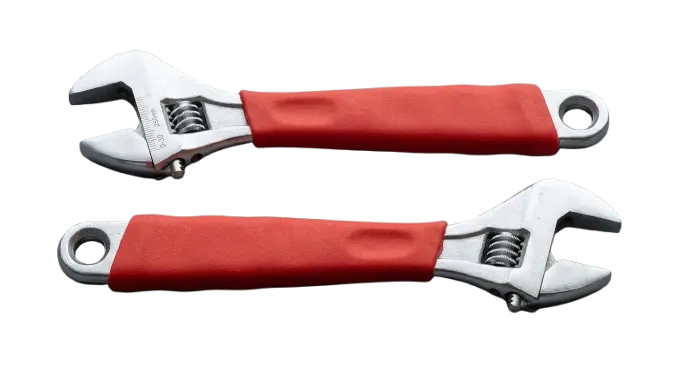
What is an adjustable spanner pair?
An adjustable spanner (often called a crescent wrench) utilizes a moveable jaw controlled by a precision knurled thumb screw thread. Buying them as a matched pair gives you the ultimate mechanical advantage for tightening and loosening plumbing fittings.
In almost all home maintenance settings, attempting to rotate a compression nut without stabilizing the adjoining valve body will wrench the underlying pipework out of alignment. Operating an adjustable spanner pair allows one tool to anchor the pipe fixture completely steady while the second spanner smoothly rotates the connecting lock-nut.
Why adjustable spanners fail and what to look out for
Low-grade or cheap drop-forged carbon steel spanners can be highly problematic. Understanding common points of structural wear helps you choose trade-grade pairs:
How long does a premium pair last? A high-quality Chrome Vanadium (Cr-V) steel spanner pair from an established brand can easily last 15–20 years under heavy domestic DIY conditions if kept clean and lightly lubricated.
Standard sizes and configurations for a spanner pair
Adjustable spanners are historically designated by their overall handle length rather than jaw opening width. The ideal configuration for a trade pair balances high leverage with agility:
| Wrench Length | Typical Jaw Max Capacity | Primary Applications | Ideal Companion for Pair |
|---|---|---|---|
| 6-inch / 150 mm | Up to 20 mm - 24 mm | Small brass fittings, tight vehicle engine bays, cycle repairs | Pairs perfectly with a 10-inch spanner for balancing leverage. |
| 8-inch / 200 mm | Up to 28 mm - 30 mm | Standard 15 mm & 22 mm compression plumbing joints, tap nuts | Pairs perfectly with a 12-inch spanner for major home pipework. |
| 10-inch / 250 mm | Up to 33 mm - 36 mm | Large radiator valves, under-sink waste traps, oil filters | The heavy-lifting anchor half of an agile 6-inch/10-inch toolkit combo. |
| 12-inch / 300 mm | Up to 38 mm - 42 mm | Main water service stopcocks, industrial pipe junctions | Provides maximum holding torque when loosening seized legacy fittings. |
Pro-Tip on Jaw Variations: Modern trade spanners offer "wide-mouth" thin jaw variants. This allows a shorter, highly compact 6-inch wrench handle to open as wide as a standard 10-inch wrench, giving you maximum clearance under tight bathroom vanity units.
Spanner pairs vs buying full fixed spanner sets
While mechanical engineering environments lean on full fixed combination sets, residential maintenance typically thrives on a dual-adjustable toolkit layout.
⚠️ SEO Note: A single premium pair of adjustable spanners handles both metric and imperial (BSP) threads effortlessly. This bypasses the need to purchase individual fixed spanners, saving you massive storage weight and physical toolkit footprint.
| Format | Average Cost | Fastener Versatility | Portability Factor |
|---|---|---|---|
| Adjustable Pair (Small + Large) | £25–£55 | Infinite (Adapts instantly to all standard metric & old imperial sizes) | High — fits cleanly inside a small tool pouch or glove box |
| Fixed Spanner Set (12-Piece) | £30–£75 | Limited (Only fits specific millimeter sizes provided in the tray) | Low — requires large, heavy storage rolls or molded cases |
| Budget Single Wrench | £8–£15 | Moderate (Can adjust, but cannot hold counter-torque on loose pipes) | High — but fundamentally limits your ability to do plumbing safely |
Where to buy high-quality adjustable spanner pairs in the UK
Adjustable spanners are stocked heavily across all UK hardware outlets. Look for options labeled with etched millimeter measurement scales on the tool face to speed up your jaw pre-setting.
| Retailer | Stock Status | Recommended For | Link |
|---|---|---|---|
| Screwfix | In stock | Forge Steel Adjustable Wrench Set 3 Pieces | View range |
| Toolstation | Available | Bahco 90 Series Adjustable Wrench 6", 8" & 10 | Check stock |
| Amazon UK | Wide Range | Amazon Basics 4-Piece Plumbing Adjustable Wrench | Search options |
How to use an adjustable spanner correctly — step by step
Using an adjustable wrench incorrectly is the leading cause of stripped hex heads. Follow these core engineering steps to protect your fasteners and your hands.
What you need: An adjustable spanner (or pair), safety gloves, and a drop of penetrant oil if dealing with ancient, seized hardware joints.
Clear debris from the fastener surfaces
Wipe off any grease, paint, or heavy limescale build-up from the target nut using a stiff brush or rag. If the metal faces are slick with oil or scale, the spanner jaws can slide off under load, rounding off the critical corner profiles.
Push the jaws completely onto the bolt flat
Open the adjustable jaw up wide enough to clear the hex profile, then press the tool deep onto the nut. Ensure the flat interior base of the wrench throat makes full contact with the tip of the bolt head. Never bite just the edge tips of a nut.
Eliminate any sliding play or gaps
Spin the knurled thumb screw firmly until the steel jaws clamp solidly onto the parallel sides of the fastener. Give the tool handle a slight wiggle check; if you feel sliding gaps, re-tighten the thumb wheel further before attempting to turn.
Pull toward the side containing the moveable jaw
Always turn the spanner handle so that the force pushes directly toward the open, adjustable jaw side of the framework. This directs the heavy rotational loads back into the solid, fixed steel body frame of the tool rather than straining the delicate internal rack gear pin.
💡 Pro tips for working with adjustable wrench pairs
- Use the dual-wield approach on valves: When loosening an old radiator valve, apply the larger 10-inch spanner onto the brass valve body to block it from spinning, then use the 8-inch spanner to back off the union nut.
- Protect finished chrome work: The steel jaws of a heavy wrench will scratch decorative bathroom basin taps. Wrap a layer of electrical tape or a thin rag over the chrome hex faces before adjusting to preserve the polish.
- Maintain the slider track: Periodically drop a single drop of general machine oil into the thumb screw rack gear. Spin it open and shut fully to work the lubricant in, keeping the operation silky smooth.
- Never use handle extensions: Slipping a cheater pipe over an adjustable spanner handle to gain extra leverage will warp the internal track gears. If a nut refuses to budge, apply penetrating fluid or heat instead.