No Water in House UK: Causes, Checks and Emergency Steps (2026)
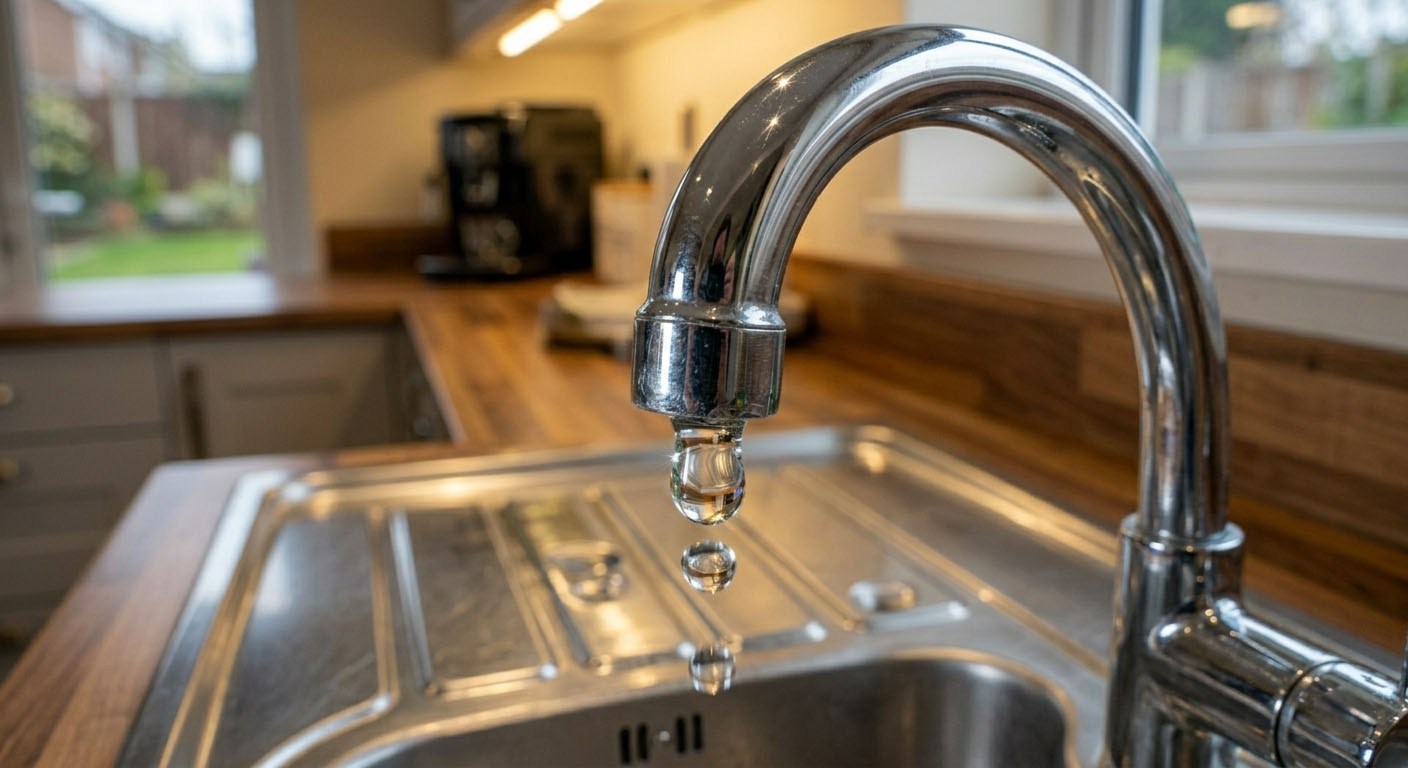
Quick answer: The most common reasons for no water in a UK house are a closed or partially closed internal stopcock, a burst main in your street, or frozen pipes in cold weather. Start by checking the kitchen cold tap, then your stopcock under the sink. If neighbours are also affected, report it to your water supplier using the numbers in the table below.
Discovering there is no water in your UK house can be an immediate cause for panic. Whether you are trying to start the morning shower or fill a kettle, a sudden loss of supply is a major disruption — but in most cases the cause is straightforward and easy to pinpoint.
Before calling out an emergency plumber, there are several checks you can do yourself to establish whether the issue is inside your property, shared with your neighbours, or a wider problem with your UK water supplier such as Thames Water, United Utilities, or Severn Trent. Working through them in order will save you both time and money.
Quick Navigation
Step 1: The Kitchen Tap Test
The first thing to do is turn on the cold tap in your kitchen. In the vast majority of UK homes, this is the point where the mains supply first enters the property — it is fed directly from the rising main rather than a storage tank.
- Water in the kitchen but not the bathroom: The problem is internal. It could be a localised blockage, an airlock, or a stuck valve on the bathroom supply branch.
- No water anywhere in the house: The fault is either your main stopcock or the external supply. Move to Step 2.
- Ask a neighbour: If they also have no water, the problem is with the regional network — almost certainly a burst water main nearby. Skip to Step 5.
Step 2: Check Your Internal Stopcock
The internal stopcock (also called a stop tap) is the valve that controls water flowing into your home from the mains. It is most commonly found under the kitchen sink, though in older properties it may be in a hallway cupboard, under the stairs, or in a downstairs toilet.
- Locate the stopcock and confirm it is fully open — turn it anti-clockwise until it stops moving.
- If plumbing work has been carried out recently, a tradesperson may have partially closed it and forgotten to open it again.
- If the valve is stiff or seized, do not force it — old brass stopcocks can snap under pressure, causing an immediate flood. Call a plumber instead.
If only the upstairs taps are affected: How to fix low water pressure upstairs
Step 3: Check the External Stop Tap
If your internal stopcock is fully open and your neighbours have water, the next thing to check is your external stop tap. This is usually located under a small metal or plastic cover set into the pavement or driveway directly outside your home.
Look for two things: any sign that the cover has been disturbed or tampered with, and any damp ground or pooling water around it, which could point to a leak on your supply pipe.
Important: In England and Wales, the water company owns and maintains the communication pipe up to your property boundary. The supply pipe running from that boundary into your home is your responsibility. If this pipe has burst or is leaking, you will need a WaterSafe-approved plumber to repair it.
Step 4: Check for Frozen Pipes
If it is a cold morning and you have suddenly lost water, frozen pipes are a strong possibility — particularly in uninsulated lofts, in properties where pipes run along external walls, or in older homes with copper supply pipes that are not lagged.
- Look for visible frost or slight bulging on exposed pipe sections.
- Open the tap on the affected run slightly so water can escape as the ice melts.
- Use a hairdryer on a low setting, a warm (not boiling) hot water bottle wrapped around the pipe, or gentle heat pads to thaw it slowly. Start from the tap end and work back.
- Never use a blowtorch or naked flame near pipework — this is a fire hazard and can cause a steam explosion in a sealed pipe.
- If a pipe has already burst due to freezing, turn off the internal stopcock immediately and call a plumber.
Once the immediate problem is resolved, lag any vulnerable pipes with foam insulation sleeves — these cost a few pounds from any DIY merchant and take minutes to fit. See our guide on how to prevent frozen pipes in winter for a full run-through.
Step 5: Contact Your UK Water Supplier
If your internal checks come back fine and your neighbours are also without water, the fault is almost certainly on the water company's network — a burst main, a valve failure, or emergency maintenance. Use the table below to find your supplier's emergency line and live status map.
| Region | Supplier | Emergency Number | Live Status |
|---|---|---|---|
| London & South East | Thames Water | 0800 316 9800 | Open Map |
| North West England | United Utilities | 0345 672 3723 | Open Map |
| Midlands | Severn Trent | 0800 783 4444 | Open Map |
| East of England | Anglian Water | 0345 714 5145 | Open Map |
| Yorkshire | Yorkshire Water | 0345 124 2424 | Open Map |
| South West England | South West Water | 0344 346 1010 | Open Map |
| Scotland | Scottish Water | 0800 077 8778 | Open Map |
| Wales | Dŵr Cymru / Welsh Water | 0800 052 0130 | Open Map |
Tip: Most UK water companies also have a 24/7 social media support team on X (Twitter) or Facebook. For burst mains updates, social media is often faster than the phone lines during busy periods.
Under the Guaranteed Standards of Service, if your supply is interrupted for more than 12 hours without prior notice, you are entitled to an automatic payment from your water company. If the outage is prolonged or you feel the response is inadequate, you can escalate the complaint to Ofwat, the industry regulator.
Step 6: Protect Your Boiler While the Water Is Off
Modern combi boilers and system boilers have low-pressure safety sensors that will shut the unit down automatically if the water supply drops. However, it is still good practice to turn your heating system off if you expect the water to remain off for more than an hour.
- Switch the boiler to "off" or "standby" rather than just turning the thermostat down.
- Do not attempt to run the hot taps or shower while the supply is off — this can introduce air into the system, which causes airlocks once the supply is restored.
- Once the water is back on, check the boiler pressure gauge. If it has dropped below 1 bar, re-pressurise the boiler before switching it back on.
Conclusion
In the vast majority of cases, no water in a UK house comes down to one of three things: a closed or seized stopcock, a burst water main outside your property, or frozen pipes in cold weather. Work through the steps above in order — starting at the kitchen tap and moving outwards — and you will identify the cause within a few minutes without spending a penny on a call-out.
If the fault is on your supply pipe between the boundary and the house, contact a WaterSafe-approved plumber to make the repair. If it is on the water company's side, log it with them promptly — they are obliged to respond, and you may be entitled to compensation if the outage runs long.
Related guides: low water pressure in the shower | low pressure upstairs | preventing frozen pipes
Questions & Answers
Real questions from homeowners — answered by our team.
Community Questions
Frequently Asked Questions
Why is only my hot water not working?
If the cold taps work fine but there is no hot water, the problem is with your heating system rather than the mains supply. Check your boiler for error codes or a pressure reading below 1 bar. A frozen condensate pipe is another common cause in winter — it is the white plastic pipe running from the boiler to an outside drain.
Am I entitled to compensation for no water in the UK?
Yes. Under the Guaranteed Standards of Service, if your supply is cut off for more than 12 hours without advance notice, your water company must make an automatic payment to your account. For planned outages, they are required to give at least 48 hours' notice. Contact your supplier to claim, or escalate to Ofwat if they do not respond.
Should I turn off my boiler if I have no water?
Modern boilers have low-pressure sensors and will cut out automatically. However, it is safer to switch the boiler off at the programmer if you expect the supply to be off for more than an hour, to avoid any risk of dry-firing the heat exchanger once pressure drops.
What if water is only coming out as a tiny trickle?
A slow trickle rather than no flow at all usually points to low pressure rather than a complete supply failure. The most common causes are a partially closed stopcock, a small leak in the supply pipe, or the water company carrying out nearby works. See our guide on low water pressure in UK showers for a full diagnostic walkthrough.
How long can a UK water company legally cut off my supply?
There is no absolute legal time limit, but the Guaranteed Standards of Service require water companies to restore supply within specified windows and to compensate customers for unplanned outages exceeding 12 hours. If an outage is prolonged or poorly communicated, you can complain to the company directly and then escalate to Ofwat.
Who is responsible for the water pipe between the street and my house?
The water company owns and maintains the communication pipe up to your property boundary. The supply pipe running from that boundary into your house is your responsibility. If this pipe leaks or bursts, you will need a WaterSafe-approved plumber to carry out the repair — the water company will not fix it.