Low Water Pressure in Shower UK: Causes and Fixes (2026)
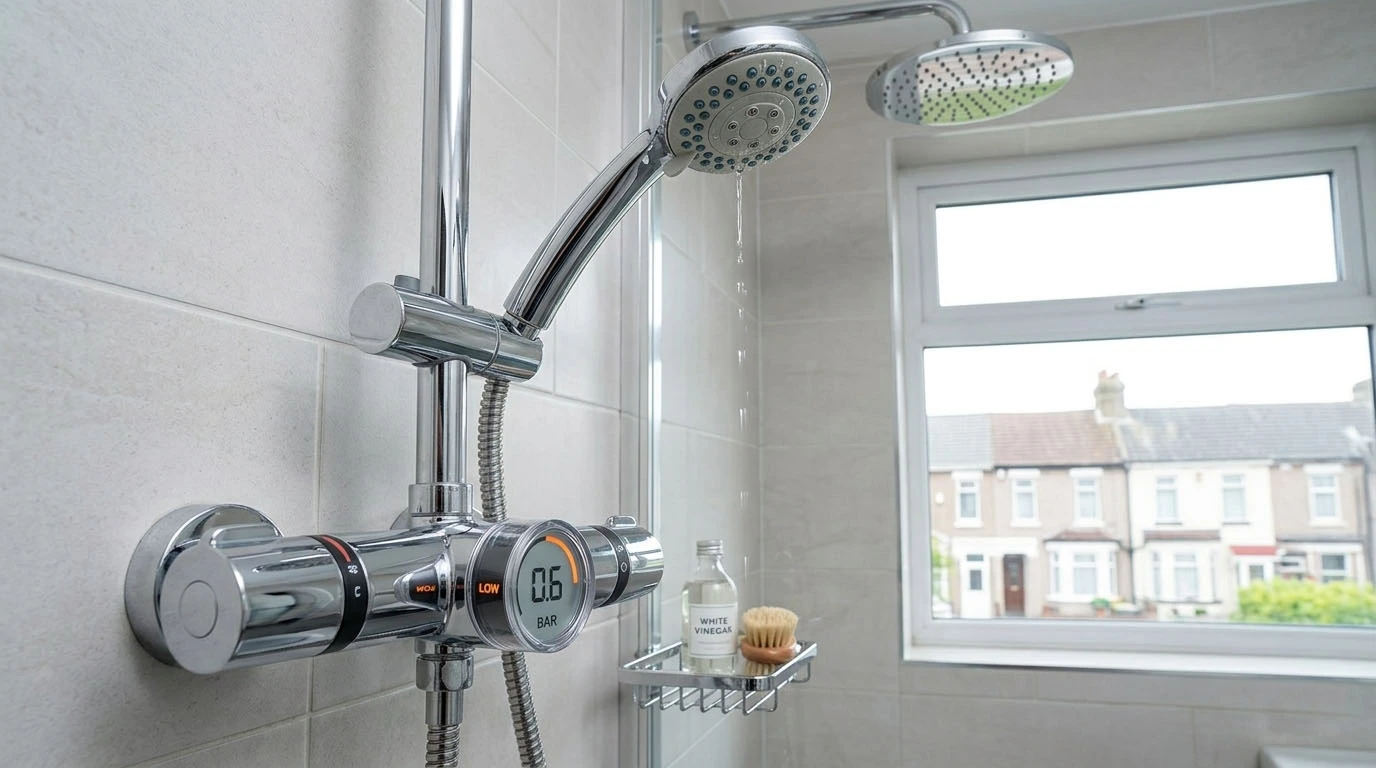
Quick answer: Low water pressure in a UK shower is most commonly caused by limescale blocking the shower head, a combi boiler sitting below 1 bar, or a gravity-fed cold tank that isn't high enough above the shower. Start by descaling the head; if that doesn't work, check your boiler gauge or call a WaterSafe-approved plumber.
Quick Navigation
Introduction
There is nothing quite as disappointing as stepping into the shower expecting a powerful blast, only to be met with a pathetic trickle. If you are struggling with low water pressure in your shower in the UK, you are certainly not alone.
Weak shower pressure is one of the most common complaints among UK homeowners and renters. Whether you live in a modern apartment or a period terrace, the cause is usually a combination of plumbing design, local infrastructure, or simple maintenance issues — and most of them are fixable without a plumber.
This guide walks you through every likely cause, a set of quick DIY checks, and a clear step-by-step repair process. We have also included guidance on when the problem goes beyond DIY and a plumber is the safer option.
Why Is My Shower Water Pressure Low?
In the UK, several specific factors contribute to weak shower pressure. Understanding which one applies to your home is the first step toward a fix:
- Gravity-fed systems: Many older UK homes use a cold water tank stored in the loft. If the tank is not high enough above the shower head, gravity cannot provide enough "push." You need roughly one metre of height to generate 0.1 bar of pressure.
- Limescale build-up: In hard water areas — common across London, the South East, and the East Midlands — mineral deposits gradually narrow the shower head nozzles and internal pipe bore. This is the single most common cause.
- Combi boiler pressure drop: If the boiler's internal pressure falls below 1 bar, hot water delivery weakens noticeably. The gauge is visible on the front of the boiler.
- High simultaneous demand: Running the kitchen tap or the washing machine at the same time can divert flow away from the shower.
- Mains infrastructure: During peak morning hours, or if there is a nearby burst pipe, your water supplier may reduce pressure temporarily. This affects the whole street, not just your home.
- Faulty pressure reducing valve (PRV): Some properties have a PRV fitted to the rising main. If it sticks or fails, it can throttle pressure throughout the house.
If the problem only affects the shower upstairs and not downstairs taps, read our companion guide on how to fix low water pressure upstairs. For whole-house pressure issues, see our guide on low water pressure throughout the house.
Quick Checks Before You Start
Before you take anything apart, run through these checks. They take less than five minutes and will tell you a lot about where the fault lies.
- Test other taps: If the kitchen cold tap runs fine but the shower is weak, the problem is localised. If all taps are weak, it points to the mains supply or a whole-house issue.
- Check the stopcock: Your main water valve — usually under the kitchen sink — should be fully open. A half-closed stopcock cuts pressure everywhere.
- Inspect the shower hose: A kinked or twisted hose restricts flow. Run the shower and check the hose is hanging freely.
- Check your boiler gauge: For combi boilers, the pressure needle should sit between 1 and 1.5 bar. Below 1 bar and the hot side of your shower will suffer.
- Ask the neighbours: If they are having the same issue, the problem is outside your property. Contact your water supplier — they have a statutory duty to maintain at least 1 bar at the boundary.
Common Causes and How to Fix Them
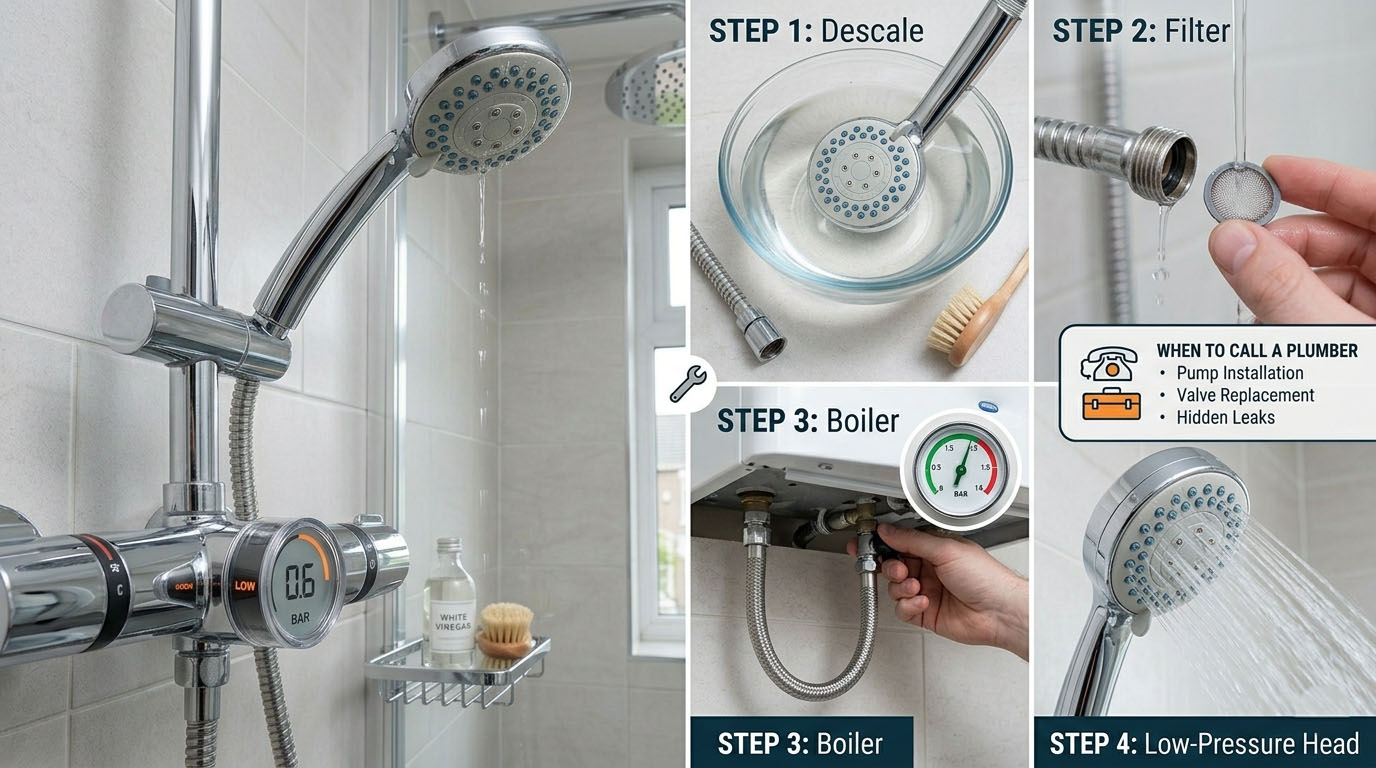
Clogged shower head (most common)
Limescale and grit build up in the tiny nozzles over time, especially in hard water areas. When the water cannot get out freely, pressure drops significantly. The fix is straightforward — a good soak in white vinegar usually clears it in an evening.
Faulty or worn mixer valve
The mixing valve balances hot and cold water inside the shower unit. If the internal cartridge is worn or clogged with debris, it cannot deliver the correct flow rate. Thermostatic valves are particularly prone to this if they have not been serviced in several years. Replacement cartridges are available for most brands and are a manageable DIY job.
Low mains pressure
Homes on an unvented system or with a combi boiler draw directly from the mains. If your water supplier's pressure is low — below 1 bar at the boundary — your shower will feel the effects immediately. You can measure this yourself using a pressure gauge on an outside tap, or report it to your supplier who is obliged to investigate under the Water Industry Act 1991.
Combi boiler low pressure
This is one of the most reported causes of weak shower pressure in UK homes. When a combi boiler loses pressure — often through a small leak or bleeding radiators — it cannot push hot water through the system effectively. Check the gauge on the front of the boiler; it should read between 1 and 1.5 bar when the system is cold. Anything below 0.8 bar and the boiler may cut out altogether.
Failing pressure reducing valve (PRV)
If your property has a PRV on the incoming mains supply and it starts to stick or fail, you can get low pressure throughout the whole house that gets progressively worse over time. PRV replacement is a job for a WaterSafe-approved plumber.
Step-by-Step Fix Guide
Work through these steps in order. Most people find the problem is resolved by step two.
Step 1: Descale the shower head
Unscrew the shower head — most twist off anticlockwise by hand, or need a cloth to grip. Fill a bowl with undiluted white vinegar and fully submerge the head. Leave it to soak for at least 4 hours, or overnight for heavy build-up. Scrub the nozzles with a small brush (an old toothbrush works well) to clear any remaining deposits, then rinse and reattach.
If the nozzles are rubber (many modern heads have them), simply flex each one with your finger under running water to break up the scale without soaking.
Step 2: Clean the filter gauges
Most modern UK showers have small mesh filters where the hose meets the shower unit and where the unit connects to the wall pipes. Unscrew the connections carefully, pull out the filters with needle-nose pliers, and rinse them under the tap. If they are badly blocked with grit, a five-minute soak in vinegar will clean them. Refit and test.
Step 3: Re-pressurise the combi boiler
Locate the filling loop — it is usually a short, silver braided hose with two valves underneath the boiler. Open both valves slowly (quarter-turn each) and watch the pressure gauge. Once the needle reaches 1.5 bar, close both valves tightly. Switch the boiler back on and run the shower. If the pressure drops again within days, you likely have a small leak somewhere in the system — call a Gas Safe registered engineer.
Step 4: Fit a low-pressure shower head
If your home has a gravity-fed system with a tank that sits close to ceiling height, you simply may not have the head height to generate strong pressure. A shower head engineered for low-pressure systems uses a narrower internal bore to increase velocity, which makes the spray feel stronger even when the volume is modest. Look for heads rated for 0.1 bar or above.
Step 5: Consider a booster pump
If none of the above resolves the problem, and your property is on a gravity-fed system, a shower booster pump is the permanent solution. These fit in the airing cupboard or loft and boost both hot and cold supplies. A twin impeller pump is best for gravity-fed systems — a plumber can install one in a few hours.
The Permanent Fix: SCALA2
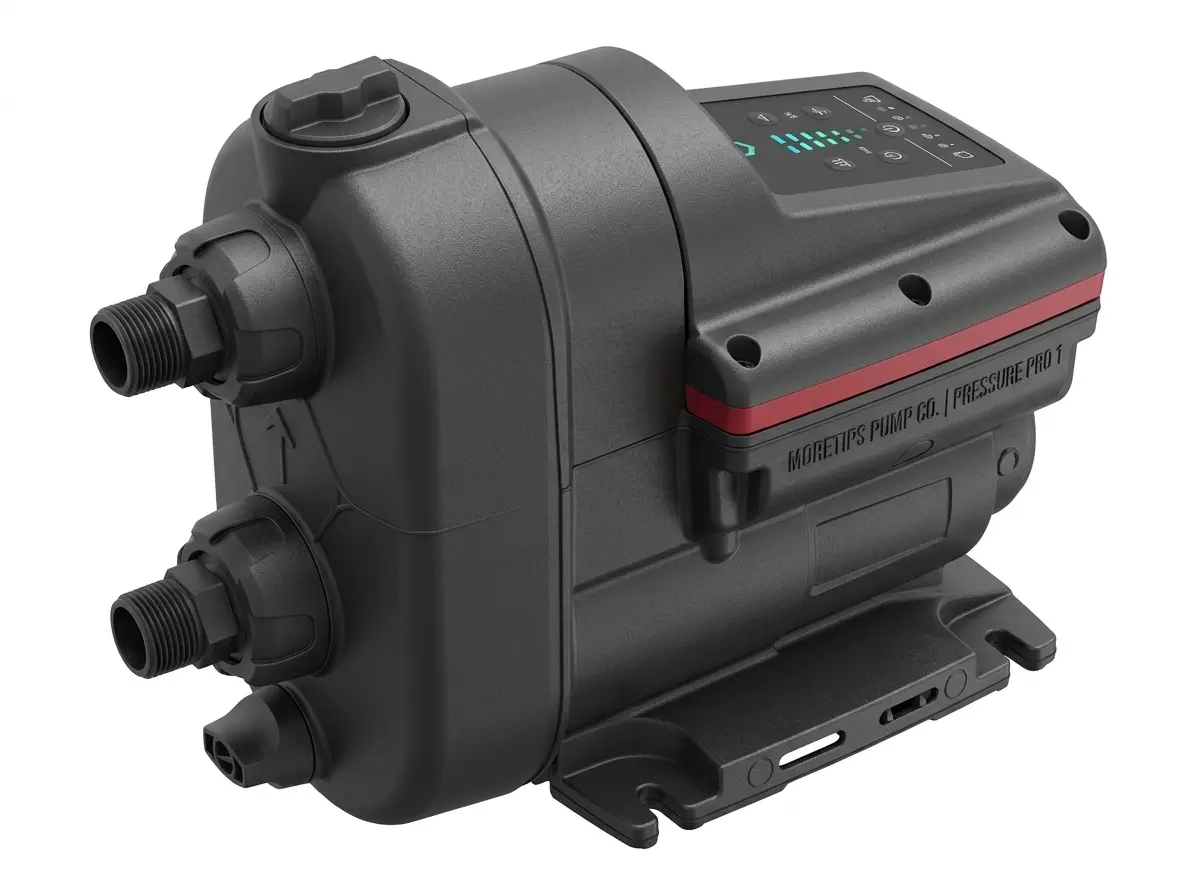
If descaling your shower head has not worked, the issue is likely your home's infrastructure. The SCALA2 is an intelligent booster pump that ensures consistent water pressure at every tap, even when the shower and kitchen sink run simultaneously.
- Whisper quiet at 47 dB
- Fits inside a standard UK kitchen cupboard
- Simple "Plug & Pump" installation
When to Call a Plumber
DIY fixes are fine for limescale and boiler pressure, but some situations require a professional:
- Pressure drops repeatedly after re-pressurising the boiler — this usually means there is a leak in the sealed system. A Gas Safe engineer needs to find and fix it before the boiler suffers damage.
- Fitting a booster pump — the pump needs to be correctly sized for your system and pipework. A poorly installed pump can cause water hammer and reduce the life of valves throughout the house.
- Replacing the mixer cartridge — if you cannot find a replacement cartridge for your specific valve model, a plumber who works on that brand regularly will have access to trade suppliers.
- Suspected pipe leak or burst — a sudden drop in pressure with no obvious cause often points to a hidden leak behind a wall or under the floor. Turn off your water at the stopcock and call a plumber promptly.
- PRV replacement — working on the incoming mains supply requires a WaterSafe-approved plumber. Find one at watersafe.org.uk.
Frequently Asked Questions
Will a better shower head fix low water pressure?
A low-pressure shower head can improve the feel of the spray by mixing air with the water, but it does not change the actual volume flowing through your pipes. For a lasting fix, you need to address the root cause — limescale, boiler pressure, or the mains supply.
Why does my shower pressure drop when someone uses a tap downstairs?
This is usually a sign that your plumbing has a limited flow rate. When another tap opens, it diverts water away from the shower — the path of least resistance is often the downstairs tap. A booster pump or a dedicated shower feed can solve this.
Is 1.0 bar pressure enough for a shower in the UK?
Most modern thermostatic shower valves require at least 1.0 bar to operate correctly. Below that, you will likely experience a weak or fluctuating flow. The ideal working range for most UK showers is 1.0 to 3.0 bar.
Can I check my home's water pressure myself?
Yes. Buy an inexpensive pressure gauge from a plumbers' merchant and attach it to an outside tap. A reading below 1 bar indicates low mains pressure. If it is consistently below this level, contact your water supplier — they have a duty to maintain at least 1 bar at the property boundary.
Does a combi boiler give better shower pressure than a gravity-fed system?
Usually, yes. A combi boiler draws directly from the mains, so you benefit from mains-level pressure rather than relying on the height of a loft tank. However, if your mains pressure is poor to begin with, a combi boiler alone will not solve the problem.
Conclusion
Fixing low water pressure in your shower in the UK does not always require a big renovation. In the majority of cases, a thorough descale of the shower head or a quick boiler re-pressurise will restore things to normal within an hour. If the fix does not stick, or the pressure is consistently weak regardless of what you try, the problem is almost certainly in your home's infrastructure — either the gravity head height is too low, or you need a booster pump.
The key is to diagnose before you spend money. Work through the steps above in order, and you will save yourself a lot of unnecessary call-out fees.