How to Unblock a Toilet Without Chemicals in a UK Home
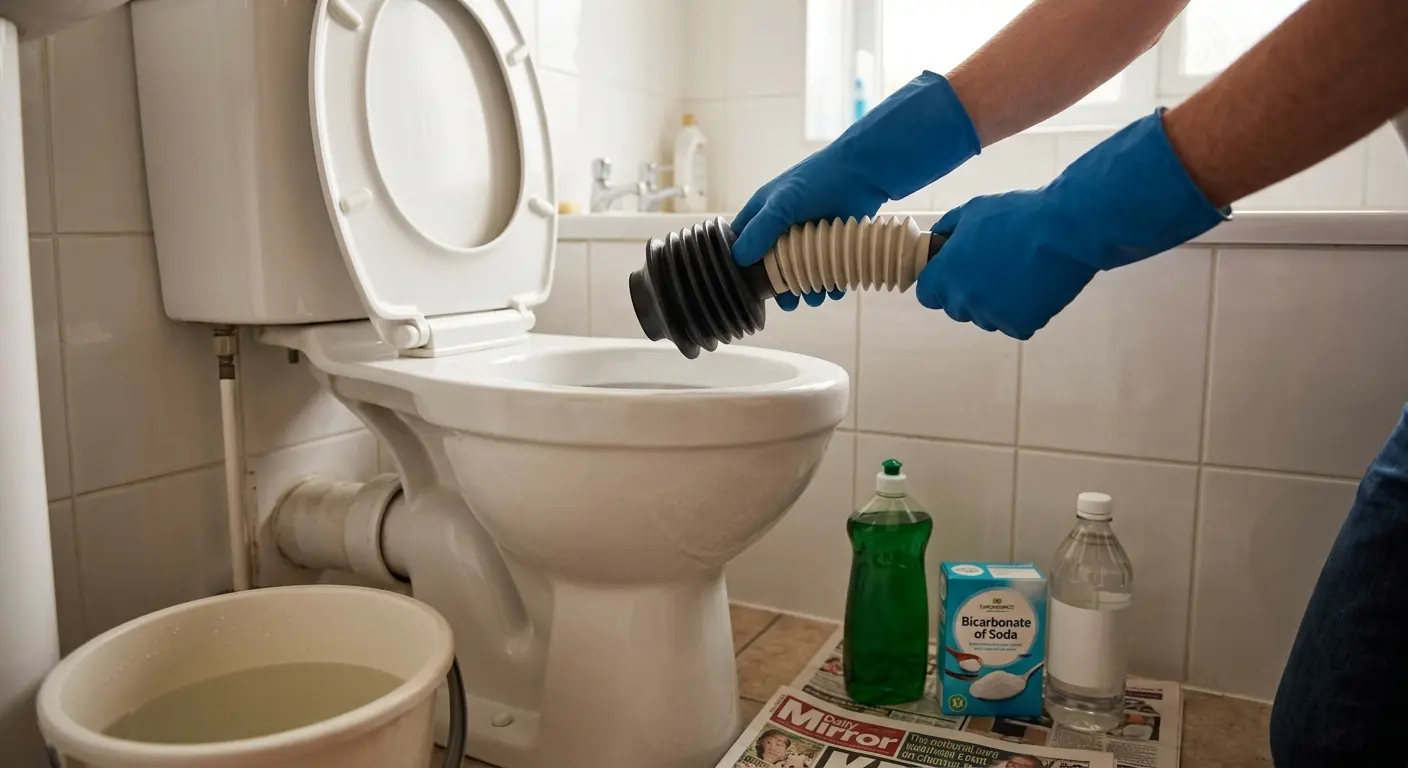
A blocked toilet is a genuine household emergency — and it always seems to happen at the worst possible moment. Before you reach for a bottle of caustic drain cleaner, it's worth knowing that chemical unblockers can crack older porcelain, damage the rubber seals in your soil pipe, and cause real harm if they splash back. In UK homes, particularly Victorian terraced houses with older pipework, the mechanical and natural methods described here are safer, faster, and in most cases completely sufficient.
This guide works through each method in order of effort, from the simplest fix you can do in five minutes to the point at which you should stop and call a plumber.
Quick Navigation
1. Common Causes of Blocked Toilets in UK Homes
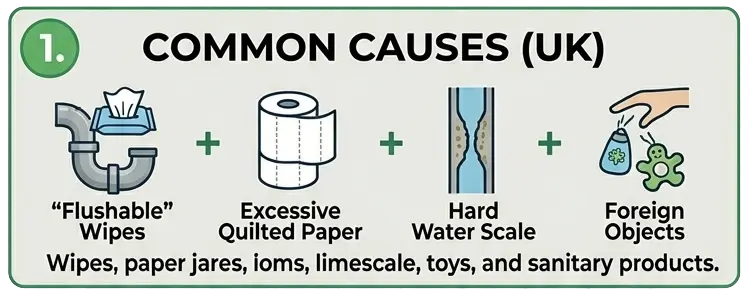
Understanding what caused the blockage is the first step to choosing the right fix. In British households, the culprits are almost always one of the following:
- "Flushable" wipes. These are the number one cause of blocked toilets across the UK. Despite the labelling, they do not break down like toilet paper and routinely snag on pipe joints in older drainage systems. Every major UK water company advises putting them in the bin, not the pan.
- Excessive or thick toilet paper. High-quality multi-ply toilet rolls are luxurious but don't dissolve quickly. Flushing large amounts in one go creates paper jams in the U-bend, particularly in low-flush toilets.
- Limescale build-up in hard water areas. If you live in the South East, East Anglia, or the Midlands, limescale deposits gradually narrow the internal bore of the toilet trap over time, making blockages more frequent and harder to shift without descaling.
- Foreign objects. Children's toys, air freshener clips, sanitary products, cotton wool, and cotton buds all cause blockages. These belong in the bin.
- Blocked or obstructed vent pipe. Every toilet has a vent pipe running up through the roof to balance air pressure in the drainage system. Leaves, bird nests, or debris blocking this vent cause slow draining, gurgling, and eventually a backed-up toilet — even when the toilet itself is clear.
2. Preparation and Safety
Before you start, contain the situation. If the water is already near the rim after one flush, do not flush again — a second flush will almost certainly overflow onto your bathroom floor.
Things to do before you start:
- Put on rubber gloves — elbow-length if you have them.
- Lay old towels or newspaper around the base of the toilet to catch any splashes.
- Open the window or switch on the extractor fan.
- If you can see the obstruction clearly (a clump of wipes, a foreign object), reach in and remove it by hand before trying anything else. That will often be the entire fix.
3. The Washing-Up Liquid Method
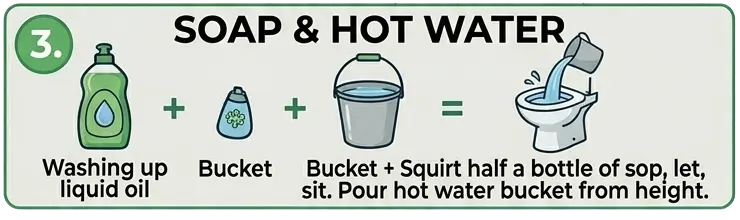
This is the best starting point for any organic blockage — waste or paper — and it works without buying anything you don't already own.
- Squirt roughly half a bottle of standard washing-up liquid into the toilet bowl.
- Leave it for 15 minutes so it sinks to the bottom and works its way around the blockage, acting as a lubricant.
- Fill a bucket with hot water from the tap — hot, but not boiling. Never use boiling water from a kettle, as the sudden heat can crack a cold porcelain bowl.
- Pour the bucket into the pan from approximately waist height in one steady pour. The weight and momentum of the water forces the lubricated blockage through the U-bend.
- Wait to see whether the water drains. If it does, flush once to confirm the toilet is clear.
This method clears the majority of simple organic blockages on the first attempt. If the bowl is still full after five minutes, move on to the plunger.
4. How to Use a Plunger Correctly
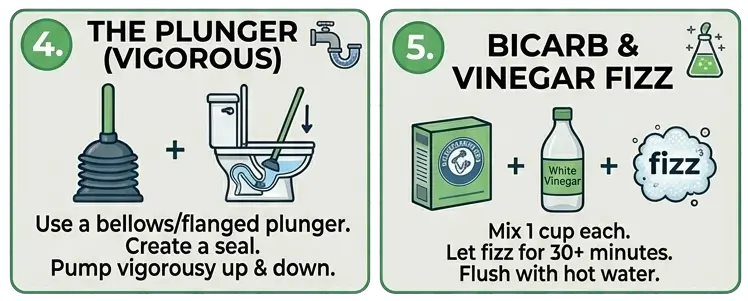
The most common plunging mistake in UK homes is using the wrong type of plunger. A flat red rubber disc — the standard sink plunger — cannot create a proper seal over a toilet's exit hole. You need either a flanged plunger (which has an extended rubber lip that fits into the hole) or a bellows plunger (accordion-shaped, generates more force per stroke). Both are available from Screwfix, B&Q, and Toolstation for £5–£15.
- Create the seal first. Push the plunger slowly into the water to expel the air from the cup before you start. Plunging with a cup full of air reduces suction significantly.
- The first stroke is a pull, not a push. Most people instinctively push first. The pull stroke creates suction that draws the blockage back and loosens it. Push to follow through, then pull sharply again.
- Pump firmly for 15–20 strokes. Keep the seal throughout. It is the alternating pressure that breaks up the blockage, not a single hard push.
- Check between rounds. After 15–20 strokes, pull the plunger free and watch whether the water level drops. If it does, the blockage has shifted — flush to confirm. If not, try up to two more rounds before moving on.
If the water drains but the toilet still flushes slowly, there may be a partial obstruction remaining. The bicarbonate of soda method below can clean up what's left.
5. Bicarbonate of Soda and White Vinegar
This method works best when the toilet is draining slowly rather than completely blocked — the fizzing reaction loosens limescale deposits and soft organic matter clinging to the pipe walls. It is also the safest option for homes with septic tanks or older lead and iron pipework common in pre-1970 UK properties.
- Pour one cup (approximately 200g) of bicarbonate of soda directly into the toilet bowl.
- Follow immediately with one cup of white vinegar.
- The mixture will fizz vigorously — this is normal and expected.
- Leave it for at least 30 minutes, or up to an hour for stubborn cases.
- Flush through with a bucket of hot water to clear the residue and check the result.
Do not expect this method to shift a complete, solid blockage on its own. Combine it with plunging for best results — plunge to break the obstruction, then use bicarb and vinegar to clean what remains.
6. Using a Toilet Auger for Stubborn Blockages
If the plunger hasn't cleared the blockage after three rounds, the next step is a toilet auger — also called a drain snake or closet auger. Do not use a metal coat hanger. It will scratch the porcelain and is too rigid to navigate the U-bend properly.
A toilet auger costs around £10–£25 from any UK plumbers' merchant or DIY store (Screwfix stock several). Here's how to use one:
- Feed the coiled end of the auger into the toilet's exit hole at the bottom of the pan.
- Turn the handle clockwise to extend the coil down through the U-bend.
- When you feel resistance, you have reached the blockage. Push and pull repeatedly to break it up, or rotate the coil to hook a foreign object and pull it back.
- Wind the auger back anti-clockwise to retrieve it, then flush to check whether the blockage has cleared.
A toilet auger can reach roughly 1–1.5 metres into the pipework — enough to clear most toilet-level blockages. If the auger goes all the way in with no resistance but the toilet is still blocked, the obstruction is further down in the soil pipe and will need a plumber with rodding equipment.
If you find yourself regularly reaching for the auger, the toilet keeps running guide is worth checking — intermittent running can sometimes be related to partial blockage symptoms affecting cistern refill pressure.
7. When to Stop and Call a Plumber
DIY methods clear the vast majority of toilet blockages. But these specific signs mean the problem is beyond what a plunger or auger can reach — call a plumber or drainage specialist at this point.
- The blockage comes back within a day or two. If you clear it and it blocks again quickly, there is almost certainly a partial obstruction further down the soil pipe catching waste as it passes. A plumber with a CCTV drain camera can find it. Expect to pay around £90–£200 for a camera survey in most UK regions.
- Multiple fixtures are draining slowly at the same time. If the sink, bath, and toilet are all sluggish simultaneously, the blockage is in the shared drain — not the toilet itself. This requires rodding or high-pressure jetting equipment.
- Water rises in the toilet when you run the bath or sink taps. Water backing up through the toilet when other fixtures run is a clear sign the soil pipe is blocked downstream. Do not use any plumbing in that bathroom until it is resolved.
- A persistent sewage smell even after unblocking. This can indicate a cracked vent pipe, a failed drain joint underground, or a broken trap seal. These are structural issues that need a proper inspection.
- The toilet is overflowing and you can't stop it. Turn off the water supply to the toilet (isolation valve on the pipe behind or underneath the cistern) and call a plumber immediately.
A typical plumber callout to unblock a toilet costs around £75–£120 in most UK areas, rising to £150–£200 for jobs requiring jetting or emergency callouts. Always use a WaterSafe-registered plumber for drainage work.
If you're also experiencing weak water flow in the bathroom, our guide on low water pressure upstairs covers the most common causes and what to check first.
Questions & Answers
Real questions from homeowners — answered by our team.
Community Questions
Unblocking a Toilet — Frequently Asked Questions
Why does my toilet keep blocking every few weeks?
Recurring blockages almost always point to one of two causes: either something is being flushed that shouldn't be (wet wipes, thick paper, sanitary products), or there is a partial obstruction further down the soil pipe — such as a wipe snagged on a pipe joint — that keeps catching new waste as it passes. If the blockage returns regularly after clearing it, a plumber should inspect the soil pipe with a camera to locate the root cause.
Can I use a coat hanger to unblock a toilet?
It is not recommended. Wire coat hangers have sharp ends that easily scratch the porcelain glaze inside the toilet bowl and pan, and they are too rigid and short to reach past the U-bend effectively. A proper toilet auger (drain snake) costs around £10–£20 from any UK DIY store and does the job safely without causing damage.
Are "flushable" wipes really safe to flush in UK homes?
No. The majority of UK water companies — including Thames Water, Anglian Water, and Yorkshire Water — advise against flushing any wipes, including those labelled "flushable". They do not break down fast enough to pass safely through UK drainage infrastructure and are the single biggest cause of blocked toilets and fatbergs in UK sewers. Bin them; do not flush them.
What type of plunger do I need for a blocked toilet?
You need a flanged plunger or a bellows plunger — not the flat red rubber disc type designed for sink drains. A flanged plunger has an extended rubber lip that fits into the toilet's exit hole and creates a proper seal. A bellows (accordion) plunger generates more force with each stroke. Both are available from Screwfix, B&Q, and Toolstation for around £5–£15.
Is it safe to pour boiling water into a toilet to unblock it?
No — never use boiling water directly from a kettle. The sudden extreme heat can crack the porcelain toilet bowl, especially if the bowl is cold. Always use hot water from the tap or water that has cooled for a few minutes after boiling. Roughly 60–70°C is sufficient to help break up organic blockages without risking damage.
Why is water rising in my toilet when I run the bathroom tap or bath?
If water backs up into the toilet bowl when you run other fixtures in the same bathroom, the blockage is not in the toilet itself — it is in the shared soil pipe or underground drain serving that part of the house. This requires a plumber or drainage specialist with rodding or jetting equipment. Do not attempt to clear this with a toilet plunger as it will not reach the problem.
Can bicarbonate of soda and vinegar unblock a fully blocked toilet?
The bicarb and vinegar method works best on slow-draining toilets where the blockage is partial. If the bowl is completely full and not draining at all, this method is unlikely to have enough force on its own. Start with the plunger method first to restore some flow, then use bicarb and vinegar to clean up what remains.